
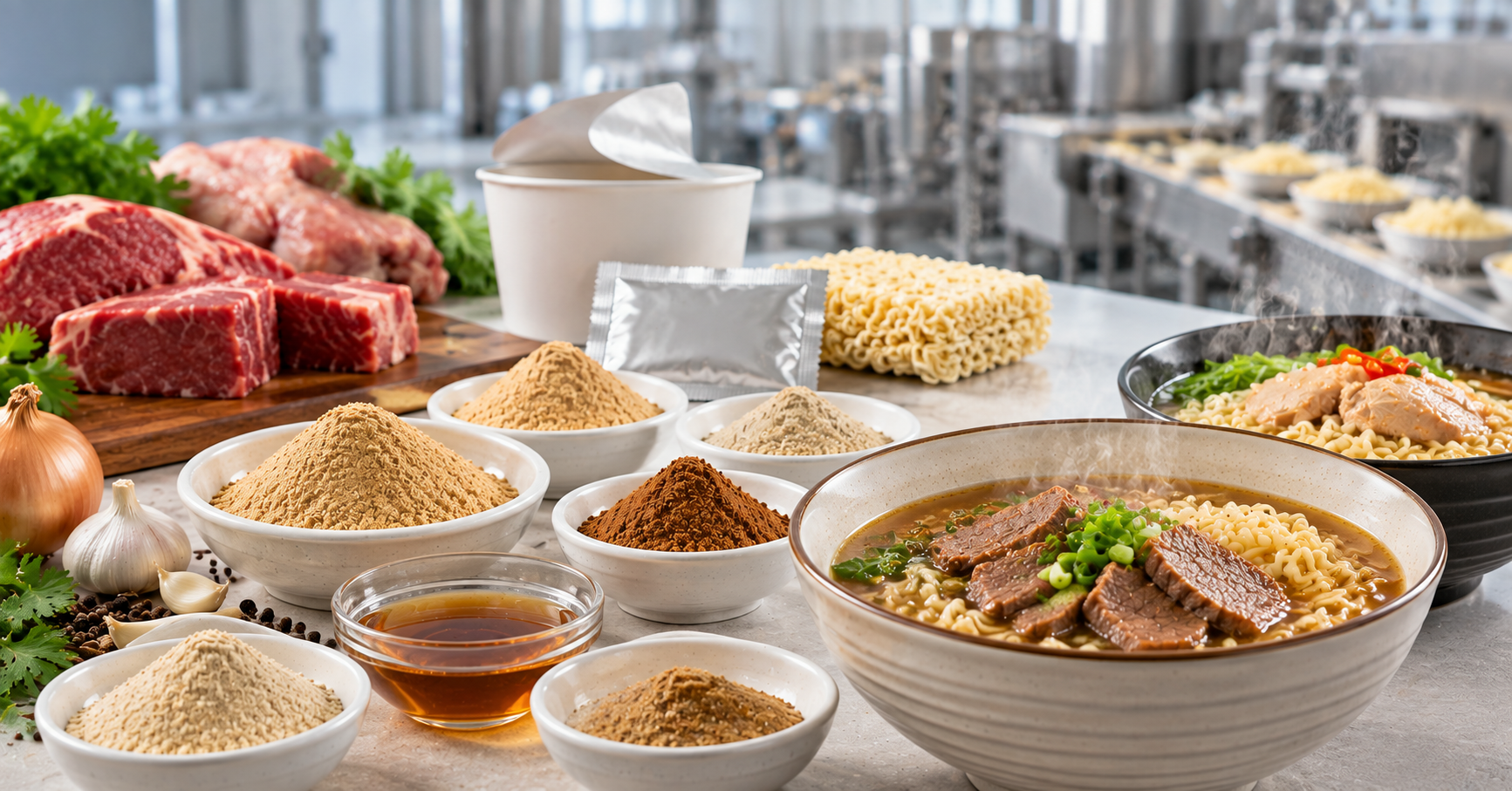
During food product development, customers often provide a reference product and ask for a similar flavor. At first this may appear to be a simple matter of identifying ingredients and copying a formula. In practice, recreating a reference product flavor requires sensory analysis, application testing and repeated adjustment.
A complete flavor does not come from aroma alone
The eating experience includes initial aroma, saltiness, sweetness, acidity, umami, body, mouthfeel and aftertaste. Two products may smell similar but taste different because the underlying taste structure is not the same.
Why can the aroma seem similar while the eating experience does not?
A top note can make the first impression close to the reference, yet differences in broth body, fat perception, spice balance or finish remain obvious during consumption. Matching must consider the full sensory sequence.
The food matrix strongly affects flavor matching
Water, oil, protein, starch, sugar and pH influence flavor release. A seasoning that works in soup may perform differently in noodles, snacks, sauces or processed meat.
Production processes can change flavor
Boiling, frying, baking, drying, sterilizing, freezing and reheating may reduce volatile notes or create new interactions. The formula must be evaluated after the same processing conditions used for the commercial product.
Why should a reference product be analyzed in flavor layers?
Breaking the profile into top aroma, main taste, body, cooked character and aftertaste helps the development team identify which part is already close and which requires adjustment.
Flavor bases can help recreate the product foundation
Flavor bases contribute savory body, continuity and depth. They often solve the problem of a sample that has the correct aroma but still feels thin.
Reaction flavors can recreate cooked or roasted character
Reaction flavors add cooked, grilled, roasted, broth-like or meaty notes. They may be combined with seasoning blends to build a more complete profile.
Do not expect perfect similarity after one trial
Flavor matching is iterative. An initial sample establishes direction; application feedback then guides controlled adjustments. Each round should focus on specific differences rather than changing everything at once.
What should customers provide for a flavor-matching project?
- A well-preserved reference product
- The actual food application and formula
- Processing and preparation conditions
- Target market and expected usage rate
- Specific characteristics to match or improve
The goal does not always need to be a 100% copy
Sometimes a commercially stronger solution is one that keeps the recognizable direction while improving stability, cost, labeling or suitability for local consumers.
Reference-based flavor development for food manufacturers
Zhongxinsheng Flavor Co., Ltd. develops customized savory systems from reference samples and target profiles. Explore our product range or send your benchmark and application information to begin.