
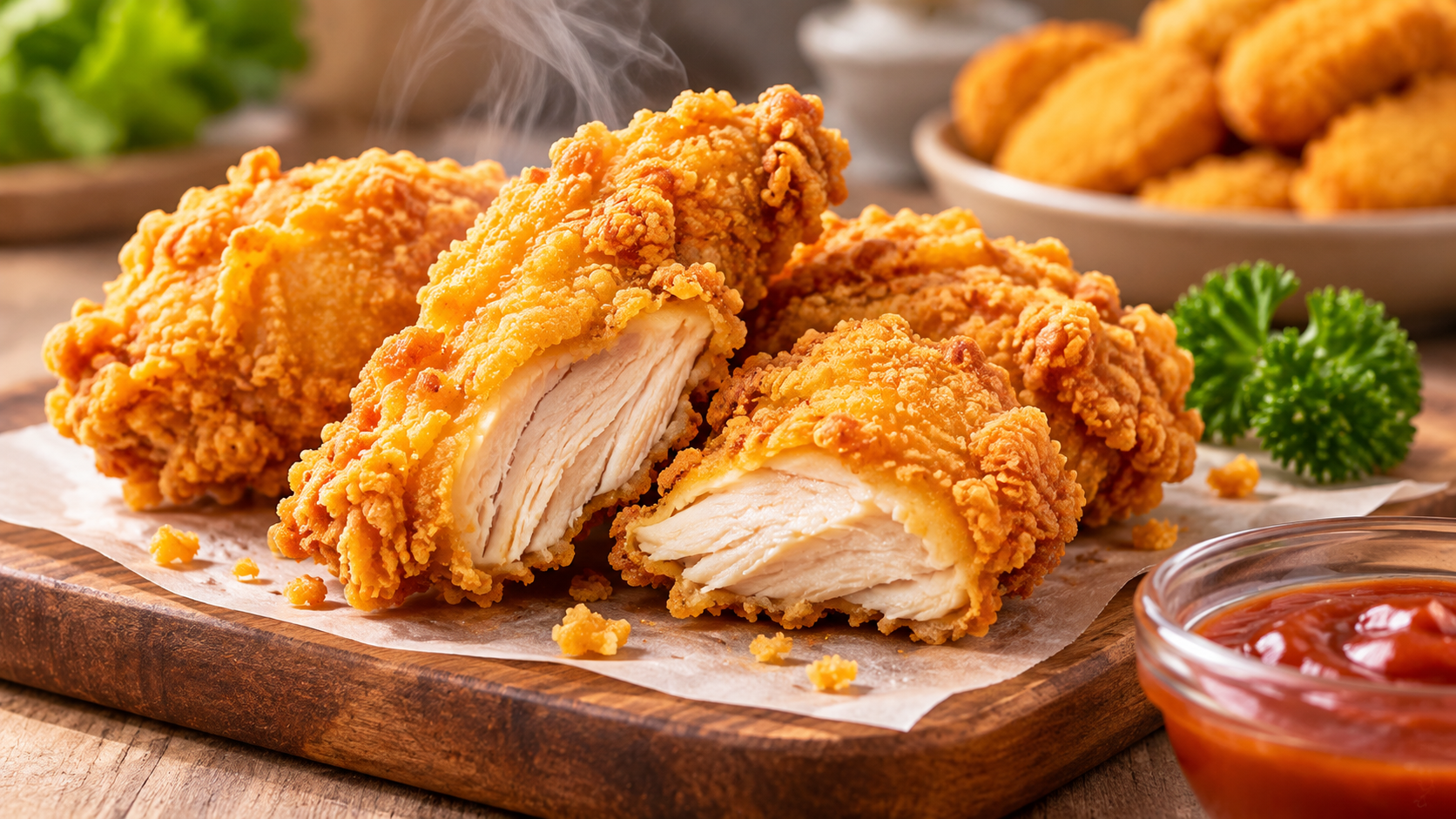
A chicken product can smell attractive during initial development but deliver a very different flavor after frying, freezing, storage or reheating.
This is a common challenge in industrial chicken products such as nuggets, breaded chicken, chicken patties, fried chicken, frozen prepared meals and other ready-to-cook poultry foods.
For food manufacturers, building a more stable chicken flavor does not simply mean choosing the strongest chicken flavor available. The finished sensory result depends on how chicken aroma, reaction flavor, savory body, seasoning, fat, moisture and processing conditions work together.
The most useful approach is to evaluate the complete flavor system through the same processing stages that the commercial product will actually experience.
Why Chicken Flavor Can Change During Frying and Freezing
Fried and frozen chicken products often pass through several stages before they reach the consumer.
Depending on the product, these stages may include:
- meat preparation;
- marination or seasoning;
- forming;
- breading or battering;
- pre-frying or full frying;
- cooling;
- freezing;
- frozen storage;
- final frying, oven heating or air frying;
- and serving.
Each stage can change the way aroma and taste are perceived.
A flavor system that performs well immediately after mixing may not produce the same result after frying and freezing. Likewise, a sample that tastes strong immediately after production may feel weaker, flatter or less balanced after reheating.
This is why flavor selection should be based on the finished application rather than only on the concentrated flavor sample.
Stable Chicken Flavor Is More Than Strong Aroma
When R&D teams describe a chicken flavor as “weak,” several different sensory problems may actually be involved.
For example:
- the initial chicken aroma may be too weak;
- the cooked chicken character may be insufficient;
- the product may smell good but lack savory body;
- the chicken identity may become less clear after frying;
- the seasoning may be strong but not well connected with the meat flavor;
- or the product may lose part of its flavor impact after freezing and reheating.
These problems should not automatically be solved by increasing one flavor ingredient.
A more effective approach is to identify which part of the overall chicken flavor system is changing during processing.
The Main Layers of a Chicken Flavor System
A complete chicken profile can contain several sensory layers with different functions.
| Flavor Layer | Main Function | Typical Problem When Unbalanced |
|---|---|---|
| Chicken Aroma | Provides recognizable chicken identity | The product lacks a clear chicken direction |
| Reaction Flavor | Supports cooked, roasted, fried or thermal chicken character | The product tastes savory but lacks cooked-meat depth |
| Savory Body / Umami | Builds fullness, depth and continuity | The aroma is present but the flavor feels thin |
| Seasoning System | Balances salt, spices, garlic, onion, pepper and other taste elements | The chicken profile feels disconnected from the total product |
| Top Notes | Support the initial aroma impact | The finished product lacks an attractive first aroma |
The correct balance depends on the product. Fried chicken, frozen nuggets and chicken patties may all require different flavor structures.
Frying Changes the Way Chicken Flavor Is Perceived
Frying creates a very different sensory environment from boiling, steaming or simply mixing a seasoning into a food product.
Oil, high surface temperature, breading, moisture loss and browning can all affect the final flavor perception.
During application testing, manufacturers may need to evaluate:
- whether the chicken aroma remains recognizable after frying;
- whether fried and roasted notes support the target profile;
- whether the breading carries too much or too little seasoning;
- whether oil masks part of the aroma;
- whether spices dominate the chicken character;
- and whether the flavor remains balanced when the product is eaten hot.
A flavor that performs well in an uncooked meat mixture should therefore not automatically be considered suitable for the fried finished product.
Frozen Chicken Products Create a Different Challenge
Frozen chicken products introduce another layer of complexity.
The product may be evaluated immediately after production, but the consumer may eat it only after freezing, storage and reheating.
For this reason, manufacturers should consider the complete use cycle.
Typical frozen chicken applications may include:
- frozen chicken nuggets;
- breaded chicken strips;
- chicken patties;
- frozen fried chicken;
- prepared chicken meals;
- chicken fillings;
- ready-to-cook poultry products;
- and other frozen savory foods.
Our Frozen Food Seasoning page also explains why frozen food seasoning should be evaluated after the actual freezing, cooking and reheating process rather than only during initial product development.
Evaluate Flavor After Reheating, Not Only Before Freezing
For frozen products, one of the most important evaluation points is the final preparation stage.
The customer may prepare the product by:
- deep frying;
- pan frying;
- oven heating;
- air frying;
- microwave reheating;
- or another cooking method.
Different preparation methods may produce different aroma release, surface texture and flavor perception.
A practical development process should therefore include sensory evaluation after the intended consumer preparation method whenever possible.
Chicken Seasoning and Chicken Flavor Are Not the Same Thing
A common formulation issue is expecting one component to perform every flavor function.
A seasoning blend and a chicken flavor may contribute to different parts of the finished product.
For example, a Chicken Seasoning Blend can help create an overall balance of chicken aroma, savory taste, salt and other seasoning components.
However, a product that requires stronger cooked, roasted or fried chicken characteristics may also need another flavor layer.
Similarly, a strong aromatic chicken note cannot completely replace the savory body and seasoning structure required in the finished product.
The development objective should therefore be a balanced system rather than simply maximizing one component.
When Reaction Flavor May Be Useful
Reaction Flavors can be considered when a chicken product needs more cooked, roasted, fried or thermal character.
This can be particularly relevant when the product has enough general chicken aroma and savory taste but still lacks the sensory impression associated with cooked meat.
Possible development targets may include:
- deeper cooked chicken character;
- fried chicken notes;
- roasted chicken character;
- browned meat notes;
- grilled-style chicken direction;
- or a more complete thermal chicken profile.
The appropriate direction should be evaluated according to the finished product and processing method.
Why Savory Body Matters After Processing
Some chicken products have an attractive aroma but become thin during eating.
This can happen when the top aroma is strong but the savory foundation is not sufficient to support it.
In this case, increasing aroma alone may not solve the problem.
Manufacturers may need to review:
- umami;
- savory depth;
- meat-style body;
- salt balance;
- seasoning structure;
- and aftertaste.
A Savory Flavor Base may be evaluated when a formulation requires a broader savory foundation and additional flavor body.
Fat Can Change Chicken Flavor Performance
Fat plays an important role in how aroma is released and perceived.
A higher-fat chicken product may present a flavor differently from a lean chicken product or a dry seasoning system.
This means that the same flavor system should not automatically be expected to perform identically in:
- fried chicken skin;
- lean chicken breast products;
- formed chicken nuggets;
- high-fat chicken patties;
- dry snack seasoning;
- or low-fat prepared foods.
When comparing samples, manufacturers should keep the food matrix consistent so that the effect of the flavor system can be evaluated more accurately.
Moisture and Breading Also Affect Flavor Distribution
Fried chicken products often contain more than the meat itself.
Marinade, batter, breading and surface seasoning may each carry part of the total flavor.
This creates several formulation questions:
- Should the main chicken flavor be concentrated in the meat or the coating?
- Does the breading mask the meat flavor?
- Does the surface seasoning become too dominant?
- Does moisture migration change flavor perception?
- Does the consumer mainly experience the coating first and the meat flavor later?
There is no universal answer. The correct distribution depends on the product concept and manufacturing process.
Do Not Judge a Chicken Flavor Only by Smelling the Sample
A concentrated sample can help identify the general flavor direction, but it cannot fully predict finished-product performance.
For industrial buyers, application testing provides much more useful information.
A suitable evaluation should consider:
- initial chicken aroma;
- cooked or fried chicken character;
- savory body;
- seasoning balance;
- aroma after frying;
- flavor after freezing;
- performance after reheating;
- aftertaste;
- and overall similarity to the target product.
A Practical Testing Sequence for Fried and Frozen Chicken Products
A structured test can help R&D teams understand which part of the flavor system needs adjustment.
- Define the target product. Confirm whether the product is fried chicken, nugget, patty, breaded chicken, frozen meal or another application.
- Define the target chicken profile. Decide whether the product should taste roasted, fried, cooked, grilled, spicy, savory or another specific direction.
- Prepare a consistent base formulation. Keep meat, seasoning, fat, moisture and processing conditions controlled during comparison.
- Evaluate the seasoning foundation. Check salt, spices, garlic, onion, sweetness and overall balance.
- Evaluate chicken identity. Determine whether the chicken aroma is recognizable enough.
- Evaluate thermal character. Check whether cooked, fried or roasted character is sufficient after processing.
- Evaluate savory body. Determine whether the product has enough depth and continuity during eating.
- Run the actual frying or cooking process. Avoid judging only the raw mixture.
- Freeze and store the test product if freezing is part of the commercial process.
- Prepare the product using the intended final cooking method.
- Compare the finished samples again. Record aroma, chicken identity, savory depth, aftertaste and overall balance.
Change One Major Variable at a Time
When several ingredients are adjusted at the same time, it becomes difficult to understand what actually improved the product.
Whenever practical, R&D teams can change one major variable at a time.
For example:
- first compare different chicken flavor directions;
- then adjust reaction flavor if cooked character is insufficient;
- then review savory body;
- then refine seasoning balance;
- and finally evaluate the complete product after the full process.
This approach can make sample feedback more useful for both the food manufacturer and the flavor supplier.
Consistency from Sample Development to Commercial Production
A flavor system that works in a small laboratory batch should still be evaluated when the product moves toward larger-scale manufacturing.
Commercial production can introduce additional variables such as:
- different mixing efficiency;
- larger batch size;
- raw material variation;
- processing time;
- frying conditions;
- freezing conditions;
- seasoning distribution;
- and final preparation method.
Our article on seasoning blend consistency from samples to commercial production discusses why flavor evaluation should continue beyond the first approved laboratory sample.
Do Not Optimize Cost by Simply Reducing Flavor
Cost reduction is important in commercial food manufacturing, but reducing the amount of one flavor ingredient without understanding its role can change the whole sensory profile.
Instead, manufacturers can evaluate the complete flavor system.
Questions may include:
- Which ingredient is mainly providing chicken identity?
- Which component provides cooked or fried character?
- Which ingredient contributes savory body?
- Is the seasoning system doing work that is being duplicated elsewhere?
- Does the flavor still perform after freezing and reheating?
- Can the target profile be achieved with a better-balanced combination rather than simply increasing total flavor addition?
This gives purchasing and R&D teams a more useful basis for cost optimization.
What Information Should Be Sent to the Flavor Supplier?
A detailed application brief can make sample selection more efficient.
Useful information can include:
- finished chicken product type;
- meat composition;
- whether the product is breaded or unbreaded;
- processing method;
- frying or cooking method;
- whether the product will be frozen;
- final preparation method;
- target chicken flavor direction;
- current flavor problem;
- existing seasoning system;
- target market;
- and benchmark product if available.
For example, “the chicken aroma is good before freezing but becomes weak after air frying” provides much more useful information than simply requesting “a stronger chicken flavor.”
Build the Flavor Around the Finished Product
The most stable chicken flavor system is not necessarily the one with the strongest aroma in the sample bottle.
For fried and frozen chicken products, manufacturers should evaluate how chicken aroma, reaction flavor, savory body and seasoning perform throughout the complete processing cycle.
The finished product should remain the main reference point.
Recommended dosage should be confirmed according to the application, formulation and target flavor profile.
Discuss Your Fried or Frozen Chicken Product
Zhongxinsheng Flavor Co., Ltd. develops seasoning blends, flavor bases, reaction flavors and application-oriented savory flavor solutions for food manufacturers.
For fried chicken, chicken nuggets, breaded poultry, frozen chicken products or prepared meals, flavor development can be discussed according to the finished application, processing method, target chicken profile and current formulation challenge.
Manufacturers can review our Chicken Seasoning Blend, Frozen Food Seasoning, Reaction Flavors and Savory Flavor Base when developing a more complete flavor system.
Contact Zhongxinsheng Flavor and share your product type, processing method, target chicken profile and current flavor problem to discuss suitable sample directions.