
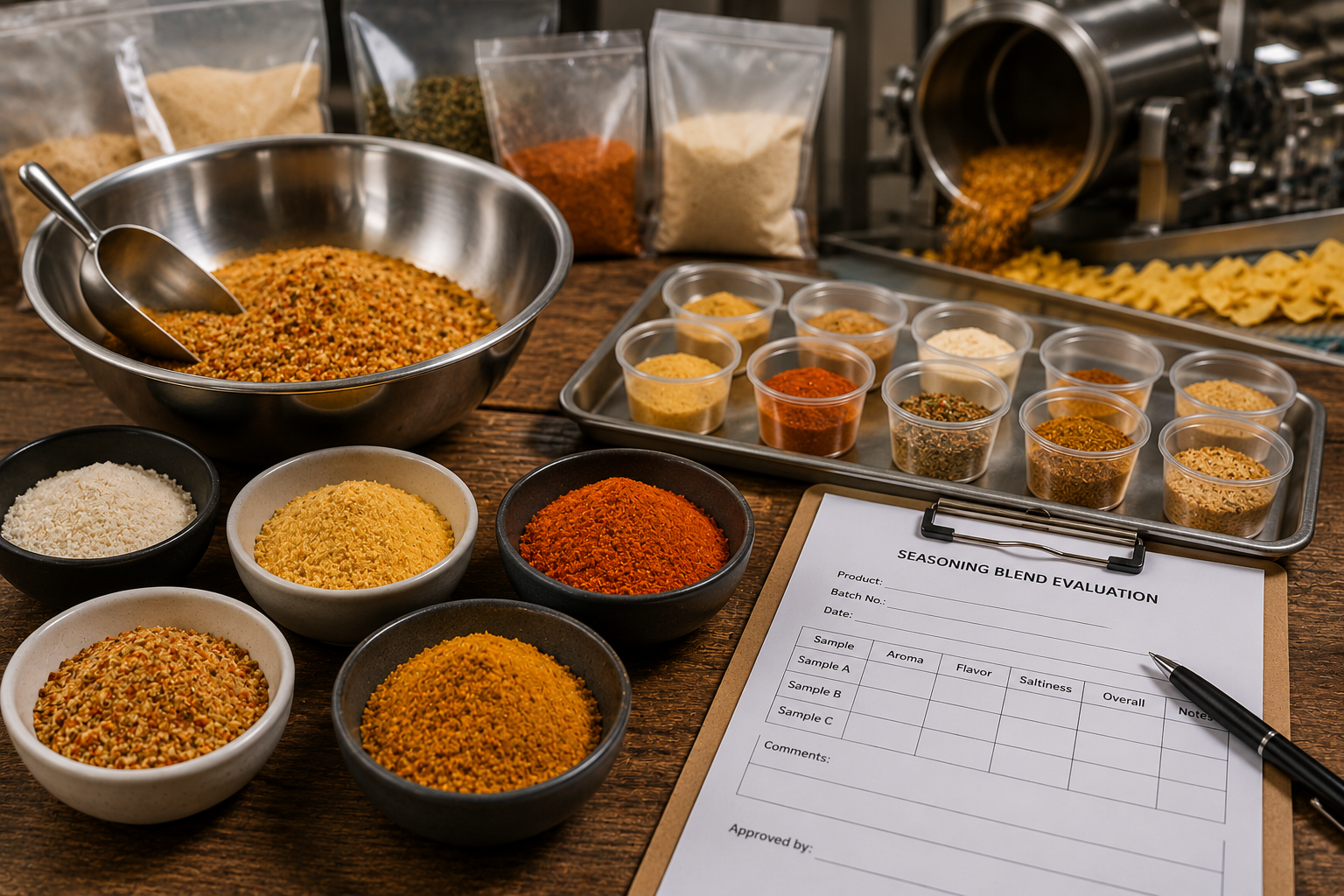
A seasoning blend may perform well during sample evaluation, but commercial food production introduces additional variables that can influence the finished flavor.
For food manufacturers, seasoning blend consistency is not only about whether different batches of seasoning taste similar. The complete food formulation, raw materials, mixing process, processing conditions and application method can all affect the final sensory result.
This guide explains the key factors food manufacturers should consider when moving a seasoning blend from sample approval to commercial production.
Why Seasoning Blend Consistency Matters
Consistency is important because consumers expect the same product to deliver a similar flavor experience from one production batch to another.
For food manufacturers, inconsistent seasoning performance may affect:
- Overall flavor profile
- Savory intensity
- Saltiness
- Spice balance
- Aroma
- Aftertaste
- Finished product identity
Food manufacturers can explore our Seasoning Blends for different savory food applications.
1. Start with a Clearly Approved Reference Sample
Before moving toward commercial production, both the manufacturer and seasoning supplier should have a clear understanding of the approved flavor direction.
The approved sample can serve as a reference during later evaluation.
Important points may include:
- Target flavor profile
- Savory intensity
- Salt and spice balance
- Aroma direction
- Application level
- Finished food formulation
- Processing method
A clearly defined reference makes it easier to identify meaningful differences during later production testing.
2. Evaluate the Seasoning in the Finished Food
A seasoning blend should not be evaluated only as a dry powder.
The same seasoning may taste different when used in noodles, snacks, sauces, soups, meat products or prepared foods.
Whenever possible, manufacturers should evaluate the seasoning in the actual finished application.
For example:
- Noodle seasoning should be evaluated in the prepared noodle and broth system
- Snack seasoning should be tested on the finished snack product
- Sauce seasoning should be evaluated in the complete sauce formulation
- Meat seasoning should be tested using the intended processing method
- Soup seasoning should be evaluated at the intended preparation or dilution conditions
Application testing helps separate seasoning-related variation from variation caused by the finished food process.
3. Consider Raw Material Variation
Food manufacturing involves many raw materials, and natural or processed ingredients may show some variation between supply batches.
Changes in the complete formulation can influence how the seasoning is perceived.
Manufacturers may need to consider variation in:
- Meat or protein ingredients
- Oil or fat content
- Salt
- Sugar
- Spices
- Starch
- Moisture
- Other formulation components
When a finished product tastes different, the seasoning blend should therefore be evaluated together with the rest of the formulation rather than assumed to be the only source of variation.
4. Mixing Uniformity Can Affect Flavor Distribution
Even a consistent seasoning blend may produce uneven flavor if it is not distributed correctly during food production.
Mixing conditions can be especially important in dry blends, snack coatings, meat products and other applications where seasoning distribution affects each portion of the finished product.
Food manufacturers may need to review:
- Mixing sequence
- Mixing time
- Batch size
- Seasoning addition method
- Powder distribution
- Oil or moisture used during application
The suitable process depends on the actual food application and production system.
5. Scale-Up Can Change the Finished Result
A seasoning system tested successfully in a small development batch may behave differently when the food manufacturer moves to larger commercial production.
Scale-up may change factors such as:
- Mixing efficiency
- Heating time
- Cooling time
- Moisture distribution
- Ingredient addition sequence
- Processing duration
For this reason, manufacturers should conduct commercial-scale or representative production testing before assuming that a laboratory result will transfer directly to full production.
6. Processing Conditions Influence Flavor Performance
Seasoning performance may change during processing.
Depending on the food product, the seasoning system may experience:
- Boiling
- Cooking
- Frying
- Roasting
- Drying
- Freezing
- Reheating
Heat, oil, moisture and processing time can influence aroma release and overall flavor perception.
Manufacturers should therefore evaluate seasoning consistency after the complete processing cycle whenever possible.
7. Control the Seasoning Addition Level
Small differences in the seasoning addition level may create noticeable changes in the finished food, particularly in products with strong savory, salty or spicy profiles.
Manufacturers should ensure that the agreed seasoning addition method can be reproduced consistently during commercial production.
When evaluating flavor differences, it may be useful to confirm:
- Actual seasoning dosage
- Batch weight
- Measurement method
- Ingredient addition sequence
- Losses during processing or transfer
The appropriate addition level should be confirmed according to the actual product formulation and development requirements.
8. Compare Production Samples with the Approved Reference
Once commercial production begins, finished product samples can be compared with the previously approved reference.
Evaluation may include:
- Overall flavor direction
- Savory strength
- Saltiness
- Spice intensity
- Aroma
- Mouthfeel
- Aftertaste
The objective is not necessarily to eliminate every small sensory difference, but to determine whether the finished product remains within the expected flavor direction.
9. Keep Formulation Changes Under Control
Changes to the seasoning blend or finished food formulation should be clearly communicated and evaluated.
Even a small adjustment may influence the overall flavor system.
Manufacturers and suppliers should confirm relevant changes before commercial implementation, especially when they involve:
- Flavor profile
- Ingredient composition
- Application level
- Processing method
- Finished product requirements
Final specifications and requirements should always be confirmed according to the actual commercial product.
10. Seasoning Blends as Part of a Complete Flavor System
In many industrial food applications, a seasoning blend works together with other flavor components rather than functioning alone.
A complete savory flavor system may include:
- Flavor Bases for broader savory foundation and flavor body
- Reaction Flavors for cooked, roasted or thermal flavor characteristics
- Seasoning Blends for overall taste, spice and seasoning balance
The role of each component depends on the finished product, target flavor profile and processing conditions.
From Sample Development to Commercial Production
A practical seasoning development process may move through several stages:
- Define the target product and flavor profile
- Develop and evaluate seasoning samples
- Test samples in the actual food application
- Adjust the flavor according to application feedback
- Confirm the preferred reference sample
- Conduct representative production testing
- Evaluate the finished product after processing
- Confirm final product and commercial requirements
This process helps connect flavor development with real manufacturing conditions.
Working with a China Seasoning Blend Supplier
When sourcing seasoning blends from China, food manufacturers should consider more than the initial sample taste or purchase price.
A suitable supplier should understand the intended food application, target flavor profile and the importance of application testing during product development.
Zhongxinsheng Flavor Co., Ltd. provides seasoning blends, flavor bases, reaction flavors and application-oriented savory flavor solutions for food manufacturers, importers and distributors.
Flavor solutions can be discussed and adjusted according to customer applications and development requirements, subject to final product confirmation.
Explore our seasoning and flavor products, learn more about our company, or contact our team through WhatsApp to discuss your seasoning requirements.
Conclusion
Seasoning blend consistency depends on more than the seasoning powder itself.
The approved reference sample, raw materials, mixing process, addition level, scale-up conditions and final food processing can all influence the finished flavor.
By evaluating seasoning blends throughout the complete food manufacturing process, manufacturers can better manage flavor consistency from development samples to commercial production.