
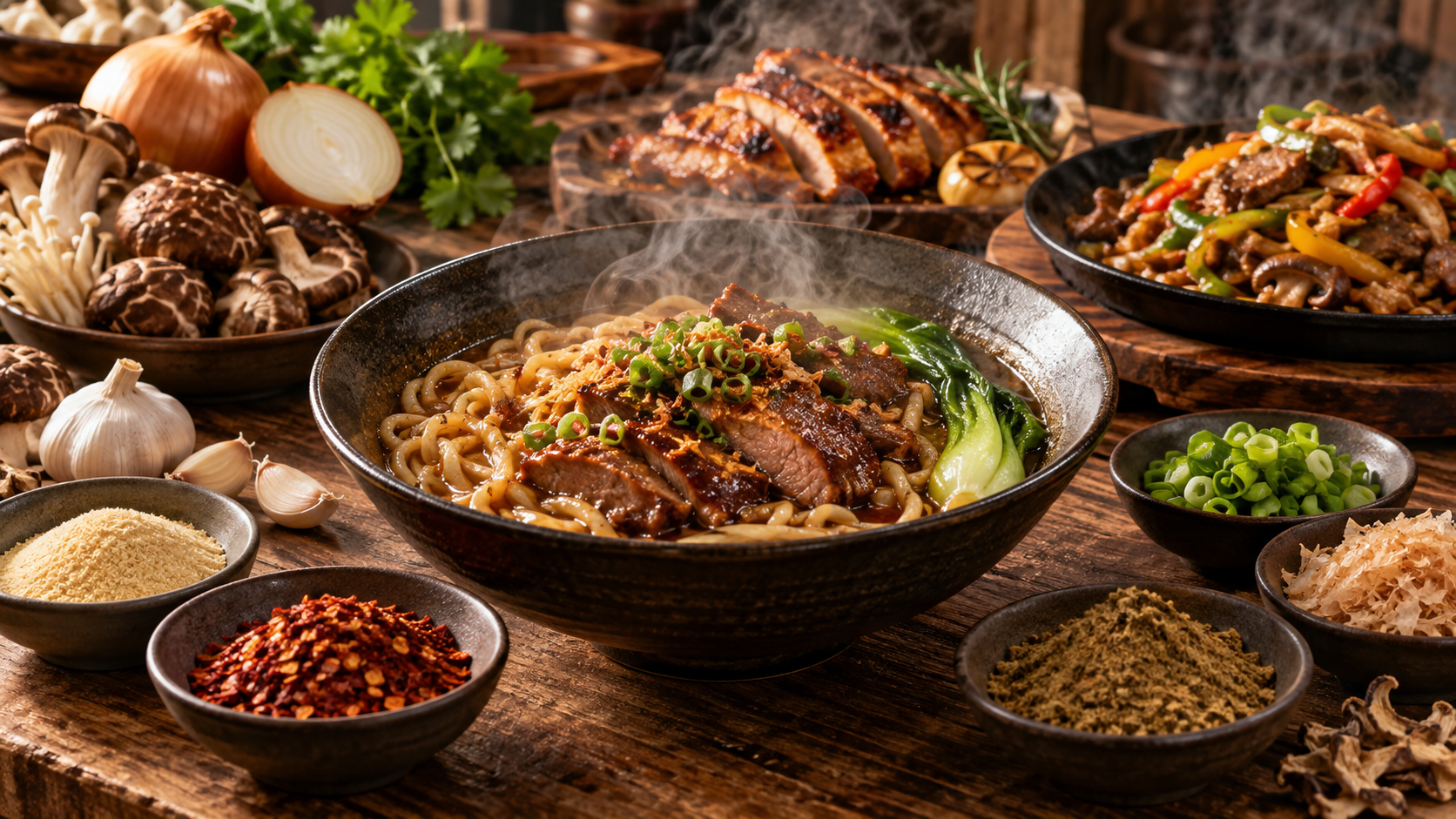
Quick Answer: When savory flavor becomes weaker after heating, food manufacturers should not automatically add more seasoning. The better approach is to identify which part of the flavor system is being lost or weakened during processing. This may involve aroma, umami, savory depth, broth body, mouthfeel, aftertaste or overall balance. Depending on the problem, manufacturers can evaluate adjustments to the seasoning blend, flavor base, reaction flavor, processing method and timing of flavor addition, followed by testing in the actual finished product.
A food product may taste balanced during early development but become noticeably weaker after cooking, frying, steaming, reheating or other processing steps.
This is a common product development challenge because the flavor perceived before processing is not always the same as the flavor perceived in the finished food.
For food manufacturers, the key question is not simply:
“How can we make the flavor stronger?”
A more useful question is:
“Which part of the savory profile becomes weaker after processing?”
Once this is identified, the flavor system can be adjusted more precisely.
What Does “Weak Savory Flavor After Heating” Mean?
A product can lose flavor in several different ways after processing.
The finished product may show:
- weaker aroma;
- less savory depth;
- reduced umami perception;
- thin broth body;
- less meatiness;
- shorter aftertaste;
- less impact at the first bite;
- or an overall flavor profile that feels flatter than the original sample.
These problems may sound similar, but they do not always require the same solution.
For example, stronger aroma does not necessarily fix weak mouthfeel, and adding more salt does not necessarily improve savory depth.
Why Can Savory Flavor Become Weaker During Processing?
Food processing changes the environment in which flavor ingredients are experienced.
Heating, dilution, oil, water, starch, protein and other formulation components can influence how the final flavor is perceived.
Some aroma components may become less noticeable after heating, while other taste components may remain present but feel less balanced in the finished formulation.
This is why seasoning should ideally be evaluated under the same conditions as the actual commercial product.
1. Aroma May Change During Heating
A product may smell strong before processing but show weaker aroma after heating.
This can happen because aroma performance changes during cooking, steaming, frying or reheating.
If the main problem is aroma loss, simply increasing salt or umami may not solve it.
Manufacturers should compare:
- aroma before processing;
- aroma immediately after processing;
- aroma after cooling;
- and aroma at the point of consumption.
This comparison helps determine whether the problem is related mainly to aroma or to the underlying savory taste.
2. Savory Depth May Be Too Weak
Some products keep their aroma after heating but still taste thin.
This usually means the issue is not only top-note aroma.
The product may lack:
- savory body;
- umami;
- broth depth;
- meaty character;
- mouthfeel;
- or a longer finish.
In this situation, manufacturers may need to evaluate the underlying flavor foundation rather than only increase the total seasoning level.
A suitable Flavor Base may be considered when the product needs stronger savory foundation, body, umami or flavor depth.
3. The Finished Product May Be More Diluted Than the Development Sample
A seasoning can perform very differently depending on how much water, oil, sauce, filling or other food material is present in the final application.
For example, a seasoning that tastes strong when tested in a small laboratory system may become weaker when used in:
- a larger soup volume;
- a high-water formulation;
- a meat filling;
- a frozen food system;
- a sauce;
- or a ready meal.
Therefore, sample evaluation should consider the actual use level and the complete finished food system.
4. Saltiness and Savory Depth May Be Out of Balance
A common development mistake is to respond to weak flavor by increasing the total seasoning amount.
This can create a product that becomes saltier without becoming more savory.
A stronger savory profile may require better balance between:
- saltiness;
- umami;
- aroma;
- savory depth;
- spices;
- mouthfeel;
- and aftertaste.
Manufacturers should therefore evaluate whether the product is truly weak in overall seasoning intensity or only weak in one specific sensory dimension.
5. The Flavor System May Not Match the Processing Method
A seasoning system developed for one type of application may not perform the same way in another.
For example, the flavor requirements of:
- boiled noodles;
- fried snacks;
- steamed dumplings;
- processed meat;
- frozen foods;
- retail sauces;
- and reheated ready meals
can be very different.
The correct flavor system should therefore be developed according to the real processing and preparation conditions.
How to Diagnose the Problem Before Adjusting the Formula
Before changing the formulation, manufacturers should define exactly what becomes weaker.
A useful evaluation can compare the product:
- before processing;
- immediately after processing;
- after cooling;
- after storage where relevant;
- and after final consumer preparation.
Then evaluate the following questions:
- Is the aroma weaker?
- Is the umami weaker?
- Does the product lack body?
- Is the broth too thin?
- Is the meatiness insufficient?
- Is the aftertaste too short?
- Has the saltiness become too dominant?
- Does the flavor become unbalanced after dilution?
This helps make the next adjustment more targeted.
Should You Add More Seasoning?
Sometimes increasing the seasoning level may improve the product, but this should not be the first automatic response.
If the problem is caused by weak savory foundation, adding more complete seasoning may also increase:
- saltiness;
- spice intensity;
- sweetness;
- chili;
- or other components that are already at the correct level.
Instead, manufacturers can consider adjusting the specific part of the flavor system that is weak.
Seasoning Blend, Flavor Base or Reaction Flavor?
Different flavor components can perform different roles in a savory food formulation.
Seasoning Blend
A Seasoning Blend generally focuses on the overall taste profile.
It may help balance:
- saltiness;
- umami;
- spices;
- aroma;
- sweetness;
- heat level;
- and the complete seasoning direction.
If the entire taste profile feels too weak or unbalanced after processing, the seasoning blend may need to be adjusted.
Flavor Base
A Flavor Base focuses more on the underlying savory foundation.
Depending on the flavor direction, it may support:
- umami;
- savory depth;
- broth body;
- meatiness;
- mouthfeel;
- and overall flavor richness.
If aroma remains acceptable but the finished product tastes thin, a Flavor Base may be one area to evaluate.
Manufacturers can explore our Umami Flavor Base for applications where broader savory depth and umami support are required.
Reaction Flavor
A Reaction Flavor may contribute cooked, roasted or thermal flavor characteristics to the overall sensory profile.
It may be relevant when the target food needs stronger:
- cooked notes;
- roasted character;
- meaty perception;
- or deeper thermal flavor characteristics.
The appropriate choice depends on the final application and the actual sensory problem.
For a broader comparison, manufacturers can also read our guide on Reaction Flavor vs. Flavor Base.
Consider the Timing of Flavor Addition
The point at which flavor components are added during production can influence the final sensory result.
In some manufacturing systems, different flavor components may be added at different production stages.
Whether this is suitable depends on:
- the food application;
- the manufacturing process;
- the type of seasoning or flavor;
- and the customer’s actual production conditions.
Manufacturers should evaluate flavor addition timing during pilot or application testing rather than assume that one method is suitable for every product.
Test the Flavor in the Actual Finished Product
One of the most important steps is to avoid judging the seasoning only as a dry powder or in water.
A seasoning system should ideally be tested in the real food application.
For example:
- instant noodle seasoning should be evaluated in the intended noodle and broth system;
- snack seasoning should be tested on the actual snack base;
- meat seasoning should be tested after the intended cooking process;
- frozen food seasoning should be evaluated after freezing and final preparation;
- and sauce seasoning should be tested in the complete sauce formulation.
This provides a much more realistic understanding of flavor performance.
How to Give Better Feedback During Sample Development
Clear feedback helps suppliers make more effective adjustments.
Instead of saying:
“The flavor is too weak.”
manufacturers can say:
- the aroma is strong before heating but weak after heating;
- the aroma remains good, but the savory depth is insufficient;
- the saltiness is correct, but the product lacks umami;
- the first flavor impact is good, but the aftertaste is too short;
- the broth is aromatic but lacks body;
- the meat character becomes weaker after cooking;
- or the seasoning becomes unbalanced after dilution.
This type of sensory feedback gives the supplier a clearer target for the next development stage.
Weak Savory Flavor in Instant Noodles
Instant noodle products may lose perceived flavor after the seasoning is diluted into the final broth.
Manufacturers should evaluate:
- broth body;
- umami;
- salt balance;
- aroma release;
- savory depth;
- and aftertaste after the noodles are fully prepared.
Flavor Base and Seasoning Blend can be evaluated together when the final broth requires both complete seasoning balance and stronger savory foundation.
Weak Savory Flavor in Meat Products
Meat products may change significantly during cooking, steaming, frying or reheating.
A suitable evaluation should consider:
- meaty perception after cooking;
- savory depth;
- aroma;
- salt balance;
- mouthfeel;
- and aftertaste.
If the product smells acceptable but tastes thin, the problem may be related more to savory foundation than to aroma alone.
Weak Savory Flavor in Frozen Foods
Frozen food products may go through multiple stages before consumption, including:
- mixing;
- freezing;
- storage;
- thawing;
- steaming;
- boiling;
- frying;
- or reheating.
Manufacturers should therefore evaluate the flavor after the complete intended preparation process.
A sample that tastes good before freezing may not necessarily produce the same sensory result after final preparation.
Weak Savory Flavor in Sauces and Soups
Liquid and semi-liquid food systems can be strongly affected by dilution, oil level, salt, sugar, acidity and other formulation components.
When a soup or sauce lacks impact after heating, manufacturers should determine whether the problem is mainly related to:
- aroma;
- broth body;
- umami;
- salt balance;
- savory depth;
- or overall flavor structure.
This makes it easier to decide whether the seasoning blend, flavor base or another flavor component needs adjustment.
A Practical Troubleshooting Process
When savory flavor becomes weak after heating, food manufacturers can follow this process:
- Test the product before processing.
- Test the product after the actual heating or cooking process.
- Identify whether aroma, umami, body, meatiness or aftertaste is weaker.
- Check whether saltiness or spice level is already sufficient.
- Review dilution and the complete food formulation.
- Evaluate whether the seasoning system matches the processing method.
- Decide whether the Seasoning Blend, Flavor Base or Reaction Flavor needs adjustment.
- Test revised samples in the actual application.
- Provide specific sensory feedback.
- Confirm the final flavor direction under commercial processing conditions.
This approach is usually more useful than simply increasing the total amount of seasoning.
Flavor Solutions for Food Manufacturers
Zhongxinsheng Flavor Co., Ltd. develops Seasoning Blends, Flavor Bases, Reaction Flavors and application-focused savory flavor solutions for food manufacturers.
When a product shows weak savory flavor after heating or processing, the development direction can be discussed according to:
- the finished food application;
- target flavor profile;
- processing conditions;
- current flavor problem;
- benchmark product;
- and sensory feedback from application testing.
Explore our seasoning and flavor products or contact us through WhatsApp to discuss your food flavor development project.