
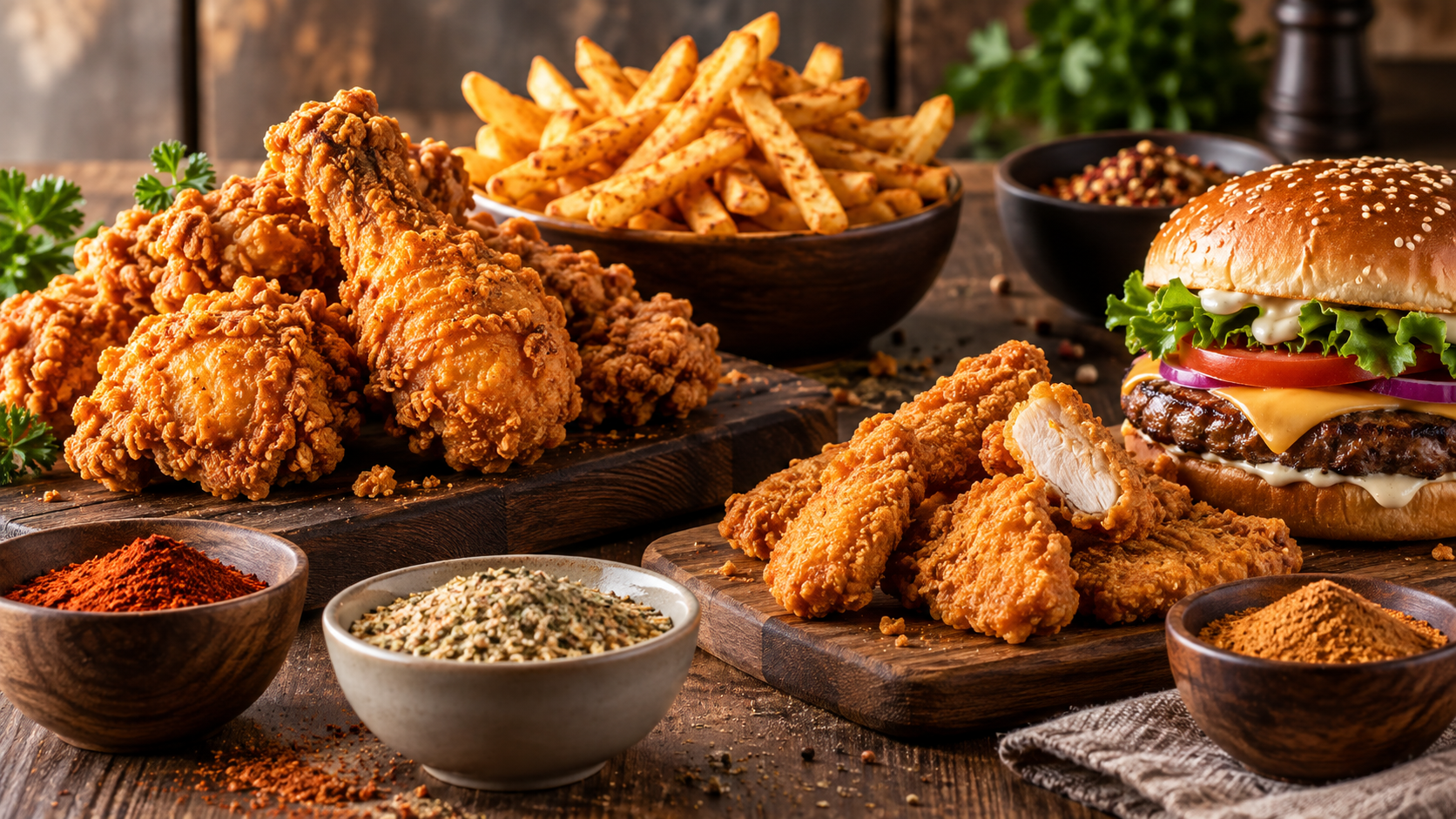
Quick Answer: A QSR custom seasoning supplier can develop seasoning and savory flavor systems for restaurant chains, central kitchens, foodservice manufacturers and co-manufacturers producing products such as fried chicken, wings, fries, burgers, sauces, marinades and other prepared foods. Seasoning profiles can be adjusted according to the target product, benchmark, processing method and market preference.
For quick service restaurant brands, flavor consistency is important because the same product may be produced in different factories, central kitchens or locations. A QSR custom seasoning supplier in China should therefore provide more than a standard seasoning powder. The supplier should understand the final food application, production process, target flavor profile and sample evaluation requirements.
Custom seasoning development can help QSR-related food manufacturers build more standardized flavor systems for commercial production while adjusting saltiness, spice level, savory intensity, aroma and other sensory characteristics according to the actual application.
What Is QSR Custom Seasoning?
QSR stands for Quick Service Restaurant. In this type of foodservice system, seasoning may be used in products produced by restaurant chains, central kitchens, food processors or third-party manufacturers.
Custom QSR seasoning can be developed for applications such as:
- fried chicken;
- chicken wings;
- chicken nuggets;
- French fries;
- burgers;
- meat products;
- marinades;
- coating systems;
- BBQ products;
- dipping sauces;
- cooking sauces;
- and other savory foodservice products.
The final seasoning should be evaluated in the actual food system because the same powder can perform differently depending on oil, moisture, protein, starch, cooking temperature and application method.
Why Do Restaurant Chains Need Customized Seasoning?
Standard retail seasoning is not always suitable for commercial QSR production.
Restaurant chains and their manufacturing partners may need greater control over:
- flavor intensity;
- saltiness;
- spiciness;
- savory depth;
- aroma profile;
- sweetness;
- smoky or roasted notes;
- aftertaste;
- and compatibility with the production process.
For example, seasoning used on French fries has different application requirements from seasoning used in a chicken marinade or a dipping sauce.
Customization allows the flavor profile to be developed around the finished product rather than forcing one standard formula into multiple applications.
How Can Seasoning Help Improve Flavor Consistency Across Locations?
For a restaurant chain, one important objective is to reduce unnecessary flavor variation between production batches or serving locations.
A more standardized seasoning system can help define key sensory targets such as:
- required saltiness;
- target spice level;
- savory strength;
- main aroma direction;
- sweetness balance;
- and expected flavor impact.
However, seasoning alone does not determine final consistency. Raw materials, cooking temperature, oil quality, coating ratio, holding time and preparation procedures can also affect the finished flavor.
For this reason, seasoning should be developed together with the actual process conditions whenever possible.
Custom Seasoning for Fried Chicken and Chicken Wings
Fried chicken and chicken wing products may use seasoning at several stages, including marinade, breading, surface seasoning or final flavor coating.
Depending on the product concept, manufacturers may require profiles such as:
- savory chicken;
- spicy chicken;
- BBQ chicken;
- garlic chicken;
- sweet and spicy;
- smoky;
- pepper-style;
- or other customized flavor directions.
For chicken-focused flavor systems, manufacturers may also evaluate our Chicken Seasoning Blend as part of the development process.
If additional savory body or chicken character is required, a suitable flavor base may also be considered according to the final application.
Seasoning for French Fries and Snack-Style Side Dishes
French fries and other surface-seasoned side dishes require the seasoning to work effectively on the finished product after frying.
Important factors can include:
- surface oil;
- seasoning particle distribution;
- coating level;
- salt perception;
- flavor impact;
- and product temperature during seasoning.
Possible flavor directions may include BBQ, cheese-style, chicken-style, spicy, garlic, smoky or sweet-spicy profiles.
For broader snack-style applications, manufacturers can also explore our Snack Seasoning.
Custom BBQ Seasoning for QSR Applications
BBQ flavor is commonly used across meat products, fries, chicken, sauces and prepared foods, but there is no single universal BBQ profile.
A QSR brand may prefer:
- smoky BBQ;
- sweet BBQ;
- spicy BBQ;
- roasted meat-style BBQ;
- garlic-forward BBQ;
- or a more savory meat profile.
The target profile should therefore be defined according to the finished product and consumer market.
Manufacturers can review our BBQ Seasoning when developing barbecue-style foodservice products.
Seasoning for Sauces, Dips and Marinades
Seasoning used in sauces and marinades behaves differently from dry surface seasoning.
In liquid or semi-liquid systems, manufacturers may need to consider:
- water content;
- oil or fat level;
- heating;
- dilution;
- acidity;
- sweetness;
- salt balance;
- and serving temperature.
For this reason, a seasoning sample should be evaluated in the actual sauce or marinade formulation.
Our Sauce Seasoning can also be considered for dipping sauces, cooking sauces, noodle sauces and related foodservice applications.
Can a Supplier Match an Existing QSR Flavor Benchmark?
A benchmark product can be useful when the buyer already has a clear target flavor.
When requesting development, the customer can provide information such as:
- the reference product;
- which characteristics should be retained;
- which characteristics should be changed;
- whether aroma should be stronger or lighter;
- whether saltiness or heat should be adjusted;
- whether more savory body is required;
- and what type of aftertaste is preferred.
The goal does not always need to be an exact copy. A benchmark can also be used as a starting point for developing a differentiated flavor profile.
What If There Is No Benchmark?
A custom project can still begin without a benchmark if the buyer provides a clear product brief.
For example:
- spicy seasoning for fried chicken;
- smoky BBQ seasoning for chicken wings;
- savory seasoning for French fries;
- sweet and spicy seasoning for chicken bites;
- or chicken-style seasoning for a prepared food product.
The more specific the product information, the easier it is to identify an appropriate sample direction.
What Information Should Buyers Provide for Sample Development?
When requesting custom QSR seasoning samples, useful information may include:
- Final food application: fried chicken, fries, sauce, marinade, meat product or another product.
- Target flavor: chicken, BBQ, spicy, savory, smoky, sweet-spicy or another direction.
- Benchmark: if a reference product is available.
- Processing method: frying, baking, grilling, mixing, marinating or another process.
- Current flavor problem: weak aroma, excessive saltiness, insufficient body, weak aftertaste or another issue.
- Target market: because flavor preferences can vary between markets.
- Expected commercial requirement: to support discussion of later production planning.
Clear information can reduce unnecessary sample rounds and make development more focused.
How Should QSR Seasoning Samples Be Tested?
Seasoning should not be selected only by smelling or tasting the dry powder.
The same seasoning can produce a different sensory result after frying, grilling, heating, dilution or mixing with other ingredients.
During application testing, buyers may evaluate:
- initial aroma;
- first-bite flavor impact;
- saltiness;
- spice level;
- savory intensity;
- overall balance;
- aftertaste;
- and performance after processing.
Feedback should be specific whenever possible.
For example, “increase the roasted aroma without increasing saltiness” is more useful for formulation adjustment than simply saying “the flavor is too weak.”
Seasoning Blend, Flavor Base and Reaction Flavor: What Is the Difference?
A complete QSR flavor system may involve more than one type of ingredient.
Seasoning Blends
Seasoning Blends can help manage saltiness, spice, umami, sweetness, aroma and overall taste balance.
Flavor Bases
Flavor Bases can help build savory depth, body and a broader flavor foundation.
Reaction Flavors
Reaction Flavors may be considered when a product requires stronger cooked, roasted, grilled or meaty aroma characteristics.
The appropriate combination depends on the target food and should be confirmed through application testing.
How to Choose a QSR Custom Seasoning Supplier in China
Price is only one factor when selecting a seasoning supplier for restaurant-chain or foodservice applications.
Buyers should also evaluate whether the supplier can support:
- application-specific development;
- custom flavor adjustment;
- benchmark-based sample development;
- clear sample feedback and revision;
- commercial production requirements;
- consistent product specifications;
- and technical communication during the development process.
A lower-cost seasoning that does not work in the final application may create additional reformulation and testing costs.
Custom QSR Seasoning Solutions from China
Zhongxinsheng Flavor Co., Ltd. provides seasoning blends, flavor bases, reaction flavors and application seasoning solutions for food manufacturers, importers and distributors.
For QSR-related projects, seasoning development can be discussed according to the finished product, target flavor direction, benchmark, processing conditions and customer requirements.
Explore our seasoning and flavor products or contact us through WhatsApp to discuss your custom QSR seasoning project.