
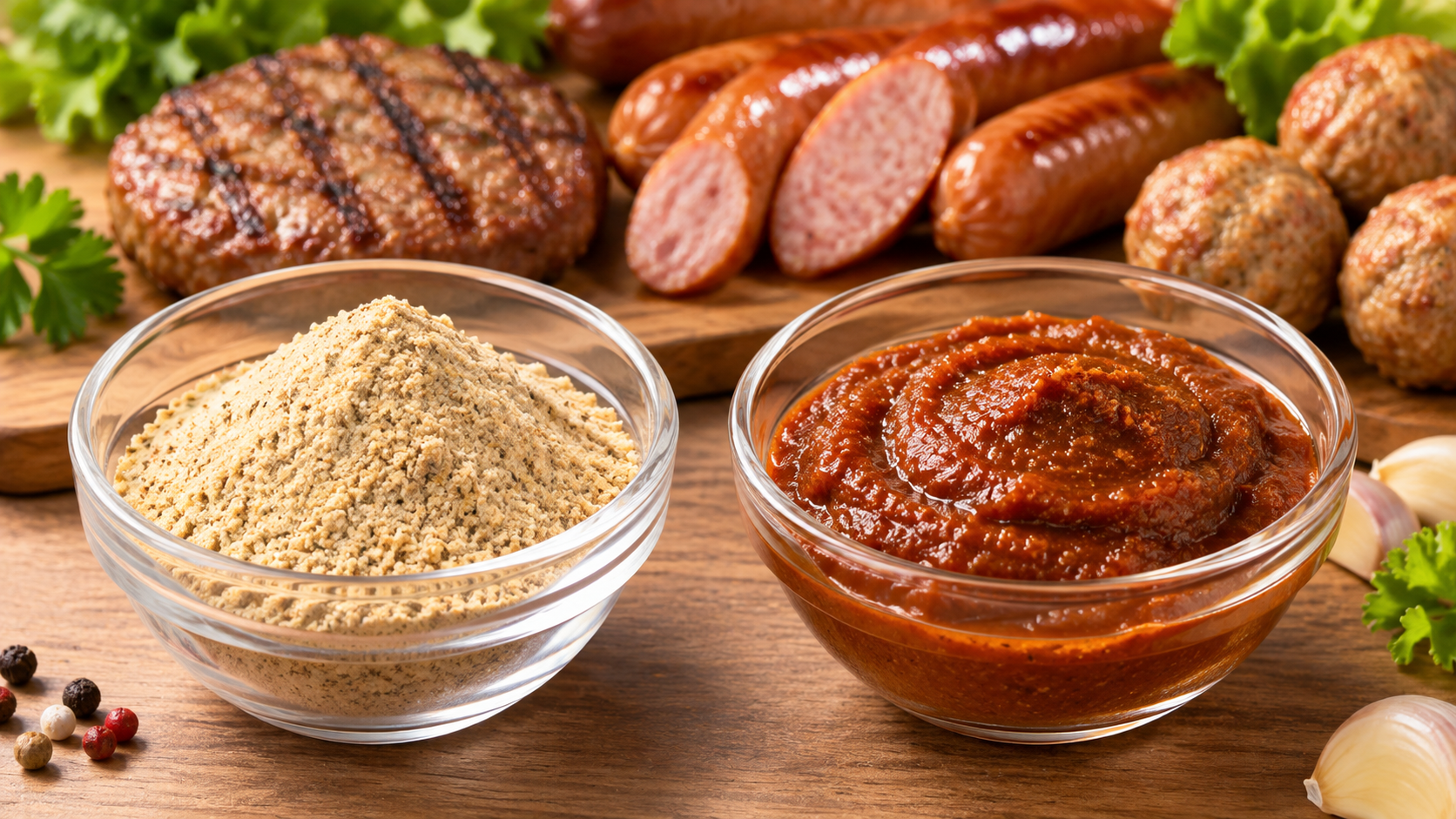
When developing a seasoning system for sausage, meatballs, processed chicken, beef products or other prepared meats, one practical question often appears early in the project:
Should the seasoning be supplied as a powder or as a paste?
There is no universal answer.
The better format depends on the finished meat product, production process, mixing method, water and fat system, target flavor profile, factory handling requirements and total cost in use.
For food manufacturers, the decision should therefore begin with the application rather than with a preference for one seasoning format.
The more useful question is not “Is powder better than paste?” but:
Which seasoning format fits this specific meat product and production process better?
Start with the Finished Meat Product
The same seasoning format should not automatically be used across every processed meat application.
A sausage, frozen meatball, burger patty, marinated chicken product and cooked meat filling can have very different formulation and processing requirements.
Before choosing powder or paste seasoning, manufacturers should first define:
- the type of meat product;
- meat species;
- fat content;
- water level;
- whether the product is emulsified, formed, marinated or coated;
- mixing and tumbling process;
- cooking method;
- freezing and reheating requirements;
- target flavor profile;
- and how the seasoning will be handled on the production line.
This application-first approach is also important when developing a broader processed meat seasoning system.
What Is Powder Seasoning?
Powder seasoning is a dry seasoning system that can combine selected taste, spice, savory and flavor components according to the finished application.
Depending on the formulation, a powder seasoning may include different components used to build:
- salt balance;
- savory taste;
- spice character;
- meat-style notes;
- aroma;
- umami;
- and overall flavor balance.
Powder formats are commonly considered when the customer’s production process already includes dry ingredient weighing and mixing.
They may also be practical when the manufacturer wants the seasoning to be incorporated together with other dry formulation ingredients.
What Is Paste Seasoning?
Paste seasoning is a more concentrated wet or semi-solid seasoning format designed around a specific application and flavor target.
Depending on the actual formulation, a paste system may combine savory components, spices, flavor bases, aroma components and other seasoning ingredients into one integrated format.
Paste seasoning may be considered when the production process already uses a wet mixing system, marinade, sauce-like phase or another formulation structure where a semi-solid seasoning format can be incorporated effectively.
The exact composition and physical characteristics should always be confirmed according to the real product specification.
Powder and Paste Are Formats, Not Quality Levels
One important misunderstanding is to assume that paste seasoning is automatically more premium, stronger or more effective than powder seasoning.
That is not necessarily true.
The physical format alone does not determine the final flavor quality.
A well-designed powder seasoning can perform very effectively in the right application, while a paste seasoning can also fail if it is not suitable for the meat matrix or production process.
The correct comparison should focus on:
- finished-product flavor;
- mixing performance;
- process compatibility;
- application consistency;
- required use level;
- factory handling;
- and total cost in the finished product.
Powder vs. Paste Seasoning: Main Decision Factors
| Decision Factor | Powder Seasoning | Paste Seasoning |
|---|---|---|
| Production format | Often suitable for dry ingredient weighing and mixing systems | May fit wet mixing, marinade or semi-liquid formulation systems |
| Handling | Can be convenient where factories already handle multiple dry ingredients | Can reduce the need to separately handle some wet or semi-solid seasoning components, depending on formulation |
| Flavor design | Can provide a complete seasoning profile when properly formulated | Can also integrate multiple savory and aromatic components into one system |
| Water contribution | Generally introduced as a dry ingredient | The seasoning itself may contribute moisture depending on its formulation |
| Mixing method | Should be evaluated for even distribution in the specific meat system | Should be evaluated for dispersion and incorporation in the specific meat system |
| Application fit | Often practical for sausages, meatballs, patties and other dry-mix compatible systems | May be useful in marinated, wet-mixed or sauce-oriented meat applications |
This table should be used as a development framework rather than as a fixed rule.
When Powder Seasoning May Be a Better Fit
Powder seasoning may be worth evaluating when the factory already operates a dry ingredient system.
Typical situations may include:
- sausage formulations where salt, spices and other dry ingredients are weighed together;
- meatball production using dry seasoning addition during mixing;
- burger or formed meat products;
- processed meat formulas where accurate dry ingredient control is preferred;
- factories that want seasoning to fit existing powder handling procedures;
- applications where the seasoning must be blended with other dry components before incorporation.
A product such as Savory Seasoning illustrates the broader concept of building a compound seasoning around salt, savory taste, spices, aroma and overall flavor balance rather than relying on one single flavor ingredient.
When Paste Seasoning May Be Worth Evaluating
Paste seasoning may be worth considering when the production process is already built around wet mixing or marinade systems.
Possible applications may include:
- marinated meat products;
- prepared chicken products;
- meat fillings;
- wet seasoning systems;
- ready-to-cook meat products;
- products where the seasoning is incorporated together with a sauce or marinade phase.
However, paste should not be selected simply because the customer expects a “stronger” flavor.
The manufacturer still needs to test whether the paste format integrates correctly with the formulation and whether the final flavor meets the target after processing.
Consider the Existing Water System
Water is an important part of many processed meat formulations.
Because powder and paste seasonings enter the formulation in different physical forms, the manufacturer should evaluate how the seasoning format interacts with the existing water system.
Relevant questions may include:
- How much water is already added to the meat formulation?
- At what stage is the seasoning added?
- Will the seasoning be pre-dispersed?
- Does the production process use marinade or brine?
- Does the seasoning format affect the intended formulation balance?
The final formulation should always be reviewed as one complete system.
Fat Content Can Also Affect the Decision
Fat content can influence how aroma, spices and savory characteristics are perceived in meat products.
A seasoning system that performs well in a lean chicken product may behave differently in a higher-fat sausage or burger formulation.
Manufacturers should therefore test powder and paste formats in the same meat base whenever they are making a direct comparison.
This helps separate the effect of the seasoning format from differences caused by the food matrix itself.
Do Not Ignore the Mixing Process
A good seasoning formula can still produce inconsistent finished products if the mixing process is not suitable.
Manufacturers should evaluate:
- when the seasoning is added;
- mixing sequence;
- mixing time;
- whether the seasoning is pre-dispersed;
- whether fat or water is added before or after seasoning;
- and whether the same distribution can be reproduced at commercial scale.
For powder seasoning, the development team should confirm that the dry components are distributed appropriately through the meat system.
For paste seasoning, the team should confirm that the paste can be incorporated consistently without creating uneven flavor concentration.
Powder vs. Paste for Sausage Production
Sausage production is a good example of why the correct format depends on the process.
Some sausage manufacturers already use dry seasoning systems containing salt, spices, savory ingredients and meat flavor components.
For these lines, a customized powder seasoning may integrate naturally into the existing process.
Other sausage formulations may include wet seasoning stages, emulsified ingredients or other components that make a paste format worth evaluating.
In both cases, the seasoning system should be judged after cooking.
The manufacturer should compare:
- meat taste;
- salt balance;
- spice profile;
- cooked aroma;
- savory body;
- aftertaste;
- and flavor consistency across the batch.
Powder vs. Paste for Meatballs
Meatballs may contain meat, fat, water, starch, seasoning and other formulation components.
A powder seasoning may be practical when all seasoning ingredients are incorporated during the main dry mixing stage.
A paste format may be evaluated if the formulation already includes a wet flavor system or if the manufacturer wants to integrate selected seasoning components into one semi-solid product.
The final decision should be based on:
- mixing performance;
- finished flavor;
- production convenience;
- batch consistency;
- and cost in the final meatball.
Powder vs. Paste for Marinated Meat Products
Marinated meat applications create a different production environment.
The manufacturer may already use water, oil, sauce, brine or another liquid phase to carry seasoning into the product.
In this situation, the choice between powder and paste should consider:
- the existing marinade structure;
- solubility or dispersion requirements;
- mixing sequence;
- target aroma;
- surface flavor versus internal flavor;
- and the final cooking process.
A paste system may be convenient in some wet applications, but powder seasoning can also be incorporated effectively when the overall process is designed for it.
Application testing should decide the result.
Does Paste Seasoning Always Give Better Flavor Persistence?
No seasoning format should automatically be described as having better flavor persistence without application testing.
Flavor persistence can depend on many factors, including:
- the flavor components used;
- meat matrix;
- fat level;
- processing temperature;
- cooking time;
- freezing;
- reheating;
- and interaction with other seasoning ingredients.
If flavor becomes weak after cooking, the problem may relate to the complete seasoning system rather than simply whether it is supplied as a powder or paste.
Heat Processing Should Be Part of the Comparison
Processed meat seasoning should be evaluated after the actual thermal process.
Depending on the product, this may include:
- steaming;
- boiling;
- frying;
- grilling;
- roasting;
- baking;
- or reheating.
Heat can change how aroma and savory characteristics are perceived.
For products that require stronger cooked, roasted or thermal meat characteristics, the seasoning system may also be supported by suitable Reaction Flavors as a technical flavor component.
The reaction flavor should support the complete seasoning system rather than define the whole product solution.
Seasoning Format and Flavor System Are Two Different Decisions
Another important point is that the physical format and the flavor structure should not be confused.
A manufacturer may choose a powder format but still require a complex system containing:
- meat-style flavor;
- umami;
- spices;
- roasted notes;
- savory body;
- and top-note aroma.
The same principle applies to paste seasoning.
The format determines how the seasoning is supplied and incorporated, while the seasoning formulation determines what sensory functions it needs to deliver.
Consider Factory Handling and Production Efficiency
Purchasing decisions should also consider what happens after the seasoning arrives at the factory.
Manufacturers may need to evaluate:
- weighing procedures;
- number of ingredients handled per batch;
- mixing steps;
- container handling;
- production line compatibility;
- cleaning requirements;
- batch preparation procedures;
- and internal storage conditions.
A seasoning format that is easy to use in one factory may create unnecessary complexity in another.
This is one reason customized seasoning development should consider the customer’s production process, not only the target flavor.
Do Not Compare Cost Only by Price per Kilogram
Powder and paste seasonings should not be compared only by quotation price per kilogram.
A more useful comparison is the total cost in the finished food.
Manufacturers may consider:
- actual use level after application testing;
- number of additional ingredients still required;
- labor and weighing complexity;
- production handling;
- packaging and transportation considerations;
- finished-product performance;
- and whether the seasoning reaches the target profile consistently.
A lower price per kilogram does not automatically mean a lower seasoning cost per finished product.
Likewise, a more concentrated or more integrated seasoning system is only commercially useful if it performs effectively in the customer’s real formulation.
Should Manufacturers Use One Complete Seasoning or Several Components?
This depends on how much formulation control the manufacturer wants to keep internally.
One company may prefer a more complete compound seasoning that already combines several taste and flavor functions.
Another manufacturer may prefer to build the final system from separate components, such as:
- seasoning blend;
- Savory Flavor Base;
- Reaction Flavor;
- umami ingredients;
- spices;
- and other application-specific ingredients.
Neither approach is automatically better.
The right level of integration depends on the manufacturer’s R&D capability, production process, purchasing strategy and target product.
How to Run a Fair Powder vs. Paste Trial
If a manufacturer wants to compare powder and paste seasoning, both should be tested under controlled conditions.
- Use the same meat base. Keep meat, fat, water and other major ingredients consistent.
- Define the same target flavor. Both samples should aim at the same finished sensory profile.
- Use the intended production process. Do not compare only by tasting the seasoning itself.
- Record the actual use level. Final dosage should be based on application testing rather than assumption.
- Evaluate the cooked product. Compare aroma, meat taste, savory body, spices, aftertaste and overall balance.
- Evaluate production handling. Record weighing, mixing and process differences.
- Compare finished-product cost. Consider the complete formulation, not only seasoning price.
What Should R&D Teams Evaluate?
A practical evaluation sheet may include:
- overall meat taste;
- savory depth;
- salt balance;
- spice profile;
- aroma before cooking;
- aroma after cooking;
- body and mouthfeel;
- aftertaste;
- seasoning distribution;
- batch consistency;
- process compatibility;
- and overall similarity to the target product.
The purpose is to identify which seasoning format performs better in the actual manufacturing environment.
Questions to Ask Before Requesting Samples
Before asking a seasoning supplier for powder or paste samples, food manufacturers can prepare several important project details.
- What meat product are you making?
- What meat type are you using?
- What flavor profile do you want?
- What problem are you trying to improve?
- What seasoning system are you currently using?
- Do you prefer powder, paste or are you open to both?
- What is the production and heat process?
- Will the product be frozen or reheated?
- What is the target market?
- What is the expected trial quantity or commercial usage?
This information helps the supplier recommend a more appropriate seasoning direction instead of simply sending a standard meat flavor.
Choose the Format Around the Production System
For meat manufacturers, powder seasoning and paste seasoning are not competing categories where one must always be better.
They are different delivery formats that can support different production systems.
The right choice depends on the meat application, formulation, mixing process, heat conditions, flavor target, handling requirements and total cost in use.
Manufacturers should therefore evaluate both the seasoning system and the physical format.
Recommended dosage should be confirmed according to the application, formulation and target flavor profile.
Discuss Your Meat Seasoning Project
Zhongxinsheng Flavor Co., Ltd. develops compound seasonings, application seasonings, savory bases and supporting flavor components for food manufacturers.
If you are developing sausage, meatballs, burger patties, marinated meat, processed chicken or another meat product, you can provide the application, current formulation, target flavor, production process and preferred seasoning format.
Our team can then discuss whether a powder seasoning, paste seasoning or another seasoning system may be more suitable for application testing.
Explore our Savory Seasoning, Savory Flavor Base, Sauce Seasoning and Frozen Food Seasoning, or contact Zhongxinsheng Flavor to discuss your meat product development project.