
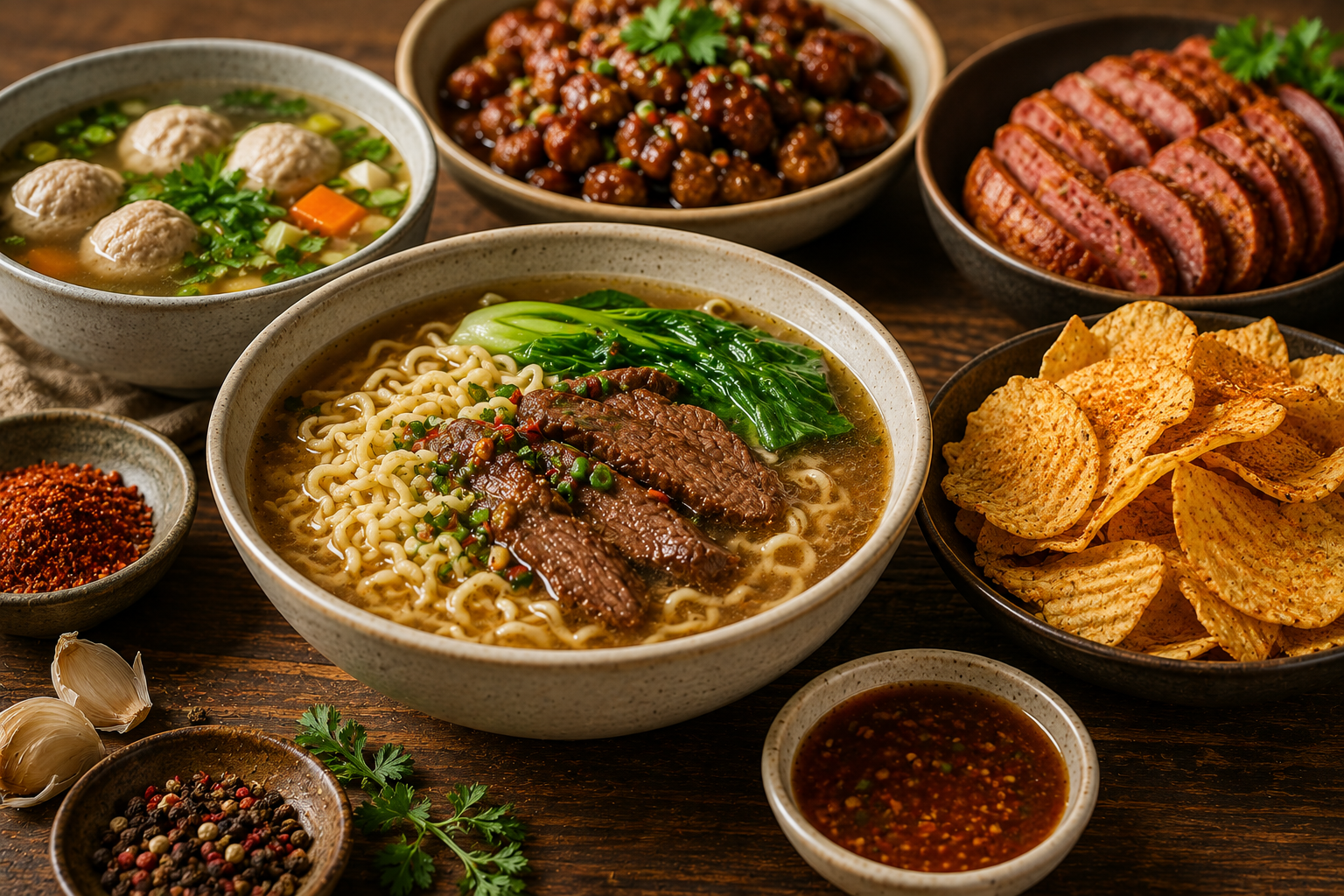
Sodium reduction has become an important formulation consideration for many U.S. food manufacturers producing processed, packaged and prepared foods.
However, reducing sodium is not simply a matter of using less salt. Salt influences more than saltiness alone. Changes in sodium levels can also affect overall flavor intensity, savory perception, aroma balance and the way other ingredients are experienced in the finished product.
For food manufacturers, the real formulation challenge is therefore how to reduce sodium while maintaining a satisfying and balanced savory flavor profile.
Why Sodium Reduction Is a Formulation Challenge
Salt plays several important sensory roles in savory food products.
When sodium is reduced, manufacturers may notice changes in:
- Saltiness
- Savory impact
- Flavor intensity
- Perceived bitterness
- Aroma balance
- Flavor body
- Aftertaste
This means that simply reducing salt without reviewing the complete flavor system may result in a product that tastes weaker or less balanced.
1. Evaluate the Complete Flavor System
Sodium reduction should be approached as part of the complete food formulation rather than as an isolated ingredient change.
Food manufacturers should consider how salt interacts with:
- Seasoning blends
- Flavor bases
- Spices
- Protein ingredients
- Fat and oil
- Acidity
- Sweetness
- Other savory flavor components
A successful reformulation may require adjustments across several parts of the flavor system rather than increasing one ingredient to compensate for lower salt.
2. Rebuild Savory Depth
When sodium is reduced, one of the most common sensory challenges is a loss of savory impact and flavor body.
Instead of focusing only on saltiness, manufacturers can evaluate the overall savory structure of the product.
Depending on the application, development may focus on:
- Stronger savory foundation
- Improved flavor body
- More balanced aroma
- Longer savory aftertaste
- Better integration between seasoning components
Our Flavor Bases can be evaluated as part of broader savory flavor development according to the finished food application.
3. Use Seasoning Blends to Rebalance the Finished Taste
A well-designed seasoning blend can help food manufacturers manage the overall taste profile after sodium levels are adjusted.
Rather than simply increasing flavor strength, the goal is to rebalance elements such as:
- Savory taste
- Spice intensity
- Aroma
- Salt perception
- Sweetness
- Acidity
- Aftertaste
Food manufacturers can explore our Seasoning Blends for different savory food applications.
4. Aroma Can Become More Important in Lower-Sodium Products
Flavor perception is not determined by saltiness alone.
Aroma can contribute significantly to how consumers experience savory foods.
In some applications, cooked, roasted or meat-style aroma characteristics may help create a richer sensory experience even when the overall sodium level is being adjusted.
Depending on the target product, manufacturers may evaluate suitable Reaction Flavors as one part of the complete flavor system.
5. Consider the Food Application
There is no universal sodium-reduction flavor strategy for every food product.
The most suitable approach depends on the application.
Different challenges may appear in:
- Instant noodles
- Soups and broths
- Snack foods
- Sauces
- Processed meat products
- Prepared meals
- Frozen foods
For example, a soup may depend heavily on broth depth, while a snack product may rely more on surface seasoning, aroma and immediate flavor impact.
6. Reduce Sodium Gradually During Product Development
For an existing product, large formulation changes can create noticeable sensory differences.
A more practical development approach may involve evaluating several sodium levels and comparing how the finished product changes at each stage.
Manufacturers can then identify which parts of the flavor system require adjustment.
Important evaluation points may include:
- Initial taste impact
- Savory intensity
- Aroma
- Bitterness or unwanted notes
- Flavor body
- Aftertaste
- Overall consumer experience
7. Test the Reformulated Seasoning in the Actual Product
Lower-sodium seasoning systems should be tested in the real finished food rather than evaluated only as a dry seasoning powder.
The complete product formulation and processing conditions can significantly influence the final sensory result.
Application testing should consider factors such as:
- Cooking temperature
- Heating time
- Moisture
- Oil or fat content
- Dilution
- Freezing and reheating
- Serving conditions
This is especially important when reformulating commercial food products where production conditions differ from laboratory testing.
8. Avoid Replacing One Problem with Another
Sodium reduction should not be treated as a reason to make uncontrolled changes to the formulation.
Increasing sweetness, spice, aroma or other flavor components too aggressively may create a different imbalance.
The objective should be to maintain an integrated flavor profile that remains appropriate for the food category and target market.
9. Keep Product Safety and Technical Requirements in Mind
Sodium and salt can also play technological roles in certain food systems.
For this reason, food manufacturers should evaluate sodium reduction together with product safety, processing, shelf-life and regulatory requirements where relevant.
Any formulation change should be validated according to the actual product and production conditions.
10. Work with an Application-Oriented Seasoning Supplier
When developing lower-sodium savory products, food manufacturers may benefit from working with a seasoning supplier that understands the complete application rather than supplying only a standard seasoning powder.
A development discussion may include:
- Current product formulation
- Target sodium level
- Desired flavor profile
- Processing conditions
- Target market
- Application testing
- Sample adjustment
As a China food ingredients and seasoning supplier, we focus on compound seasonings, flavor bases, reaction flavors and customized savory flavor solutions for food manufacturers.
Solutions can be discussed according to the actual food application and customer development requirements. Specific formulation performance should be confirmed through application testing.
Explore our seasoning and flavor products or contact our team through WhatsApp to discuss your flavor development requirements.
Conclusion
Reducing sodium while maintaining savory flavor is a complete formulation challenge rather than a simple salt-replacement exercise.
Food manufacturers should evaluate savory depth, seasoning balance, aroma, processing conditions and the complete food system when reformulating products.
By combining seasoning development with real application testing, manufacturers can work toward lower-sodium products while maintaining the flavor characteristics expected from the finished food.