
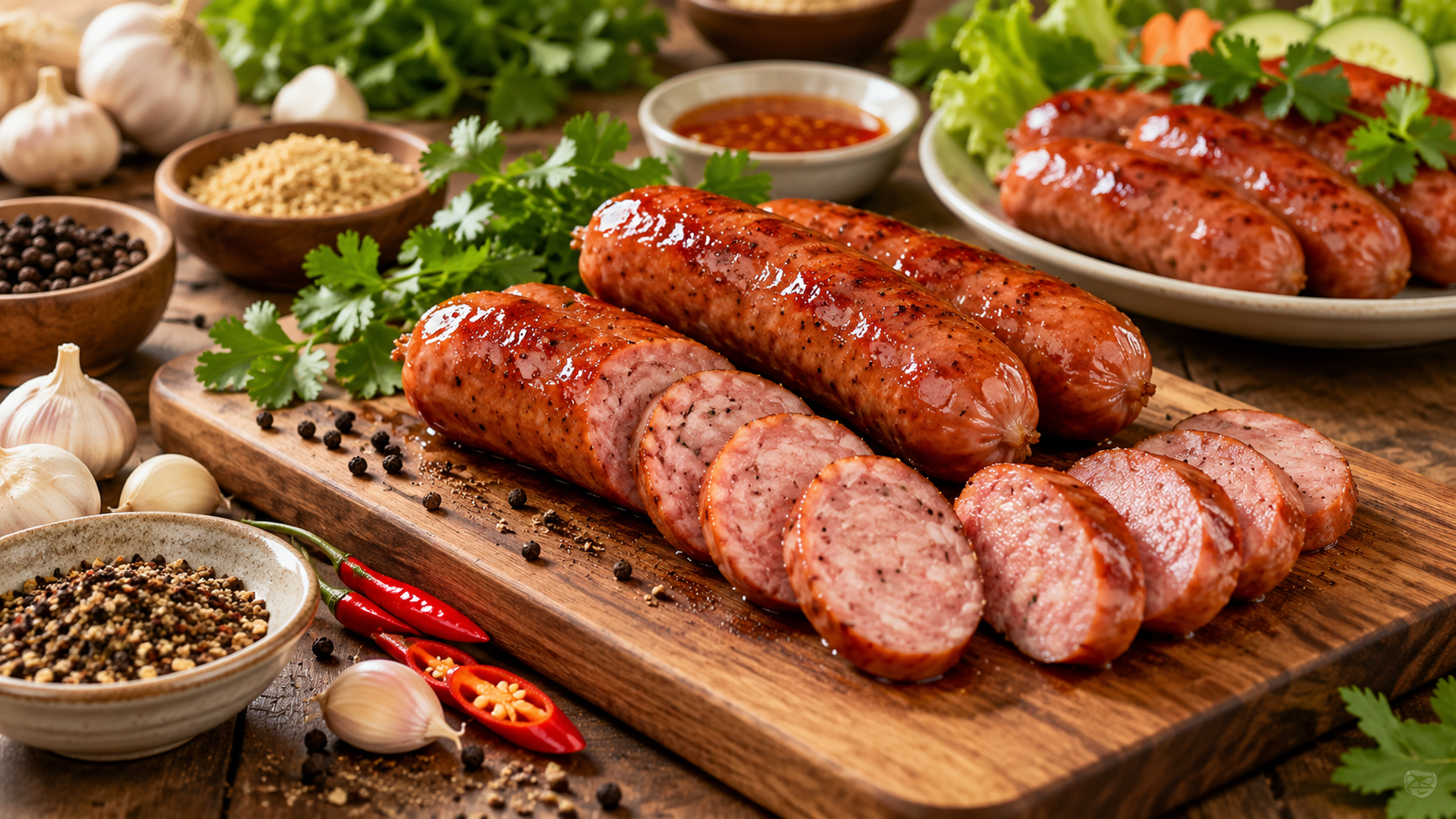
Quick Answer: To recreate a VISSAN-style sausage flavor for commercial production, food manufacturers should not focus on a single meat flavor ingredient. The better approach is to use the market product as a sensory benchmark, identify its pork character, savory intensity, seasoning balance, cooked-meat notes and aftertaste, and then rebuild these characteristics through a combination of seasoning, flavor base, reaction flavor and application testing.
The objective is not to obtain or copy a proprietary VISSAN formula. It is to develop a commercially suitable sausage flavor profile that approaches the sensory direction of the benchmark product.
Why Use VISSAN Sausage as a Flavor Benchmark?
When developing a new sausage for the Vietnamese market, starting from an existing market product can be much faster than creating a flavor direction from zero.
A benchmark gives the development team a clear sensory target:
- How strong should the meat character be?
- How much umami is required?
- Should the sausage taste more cooked, roasted or grilled?
- How strong should pepper and other seasoning notes be?
- How long should the savory aftertaste remain?
According to VISSAN’s publicly available product information, its Pork Sausage contains lean pork together with sugar, salt, pepper and flavor enhancer. This does not reveal the complete commercial formula, but it provides a useful starting point for understanding the basic taste structure of this type of sausage.
Step 1: Buy the Benchmark Product and Define the Target
The first step in flavor recreation is sensory benchmarking.
Prepare the VISSAN sausage and your own sausage under the same serving conditions. If the product is normally heated, fried or grilled, both samples should be prepared using the same method.
Then evaluate the products side by side.
A simple benchmarking sheet can include:
- Pork aroma
- Cooked meat character
- Roasted or grilled notes
- Saltiness
- Sweetness
- Umami intensity
- Pepper and spice character
- Fatty or juicy perception
- Overall savory depth
- Aftertaste
Instead of saying, “our sausage does not taste like VISSAN,” the development team should identify exactly which sensory dimensions are different.
Step 2: Rebuild the Pork Flavor Foundation
If the benchmark has a fuller meat character than the test product, simply increasing salt or MSG may not solve the problem.
The sausage may require a stronger pork flavor foundation.
A Pork Flavor Base can be evaluated when manufacturers want to strengthen the basic pork character, savory body and overall meat impression of the product.
The target is not necessarily to make the pork aroma extremely strong. The flavor base should support the meat system without making the product taste artificial or unbalanced.
Step 3: Recreate Cooked, Roasted or Grilled Meat Notes
One of the biggest differences between an ordinary meat seasoning and a convincing sausage flavor is often the thermal meat character.
During cooking, frying or grilling, consumers expect additional aroma characteristics associated with cooked meat.
Depending on the benchmark, manufacturers may evaluate a reaction flavor to build:
- Cooked pork notes
- Roasted meat character
- Grilled aroma
- Deeper savory aroma
- Longer cooked-meat aftertaste
This layer is especially important when the base sausage formulation already has sufficient salt and umami but still smells weak or lacks the characteristic cooked-meat impression after heating.
Step 4: Match the Seasoning Balance
Meat flavor alone cannot recreate the complete sensory profile of a commercial sausage.
The seasoning system also affects how consumers perceive the meat flavor.
During benchmarking, manufacturers should compare:
- Salt level
- Sweetness
- Pepper intensity
- Garlic or onion notes if present
- Other spice characteristics
- Umami level
- Overall flavor impact
A customized seasoning blend can then be adjusted around the target profile.
For example, if the benchmark tastes fuller but your sausage already has enough pork aroma, the missing element may actually be seasoning balance rather than additional meat flavor.
Step 5: Do Not Evaluate the Flavor Only in Powder or Liquid Form
This is a common mistake in flavor development.
A flavor ingredient may smell strong in the sample bottle but perform very differently after it is added to a sausage system.
The final result can be affected by:
- Meat and fat content
- Protein system
- Salt level
- Heating temperature
- Cooking time
- Frying or grilling
- Storage conditions
For this reason, a VISSAN-style sausage flavor should be evaluated in the actual sausage application rather than judged only by smelling the flavor ingredient directly.
Step 6: Run A/B Sensory Testing
Once the first prototype is ready, compare it directly against the benchmark.
A practical test may include three samples:
- Sample A: Benchmark VISSAN sausage
- Sample B: Current factory formulation
- Sample C: Improved formulation using the new flavor system
Ask the evaluation team to score each important sensory characteristic independently.
For example:
| Flavor Attribute | Benchmark | Current Product | New Prototype |
|---|---|---|---|
| Pork Character | Target | Evaluate | Evaluate |
| Cooked Meat Aroma | Target | Evaluate | Evaluate |
| Umami | Target | Evaluate | Evaluate |
| Seasoning Balance | Target | Evaluate | Evaluate |
| Aftertaste | Target | Evaluate | Evaluate |
This makes the development process much more useful than simply asking whether the prototype “tastes similar.”
What Flavor System May Be Needed?
Depending on the difference between your current sausage and the benchmark, the solution may involve one product or several layers.
Pork Flavor Base
Used to support pork character, savory body and the basic meat flavor foundation.
Reaction Flavor
Used when the product needs stronger cooked, roasted or grilled meat characteristics after thermal processing.
Seasoning Blend
Used to balance saltiness, sweetness, spices, umami and the overall seasoning profile.
In many projects, the most convincing result comes from building these elements as one integrated flavor system rather than continuously increasing the dosage of one flavor ingredient.
What Information Should You Send to a Flavor Supplier?
If you want a supplier to develop a sausage flavor close to a market benchmark, sending only the message “I want VISSAN flavor” is usually not enough.
Provide as much application information as possible:
- Benchmark product name and photos
- Target market
- Sausage type
- Main meat source
- Processing method
- Whether the product is boiled, fried or grilled
- The sensory differences in your current product
- Which characteristics you want to strengthen or reduce
If possible, sending an actual benchmark sample can make the development target much clearer.
Can a Supplier Make an Exact Copy of VISSAN Sausage?
An external supplier cannot know VISSAN’s proprietary commercial formulation simply from the finished product.
However, sensory benchmarking can be used to develop a similar flavor direction.
The realistic development objective is therefore:
benchmark product → sensory analysis → target flavor profile → prototype → application testing → adjustment
This approach is widely more practical for commercial product development than attempting to guess an unknown proprietary formula.
Develop Your Own Sausage Flavor Based on a Market Benchmark
If you are developing sausage for Vietnam or another Southeast Asian market, an existing successful product can be used as a clear benchmark for flavor development.
Zhongxinsheng Flavor develops savory flavor solutions for food manufacturers, including Flavor Base, Reaction Flavor and customized Seasoning Blend systems.
For pork sausage projects, you can start with our Pork Flavor Base or review our food flavor and seasoning products.
If you already have a VISSAN product or another sausage benchmark that you want to approach, send us the target product information and your application requirements through our Contact page. We can discuss the flavor direction that needs to be developed and tested in your application.