
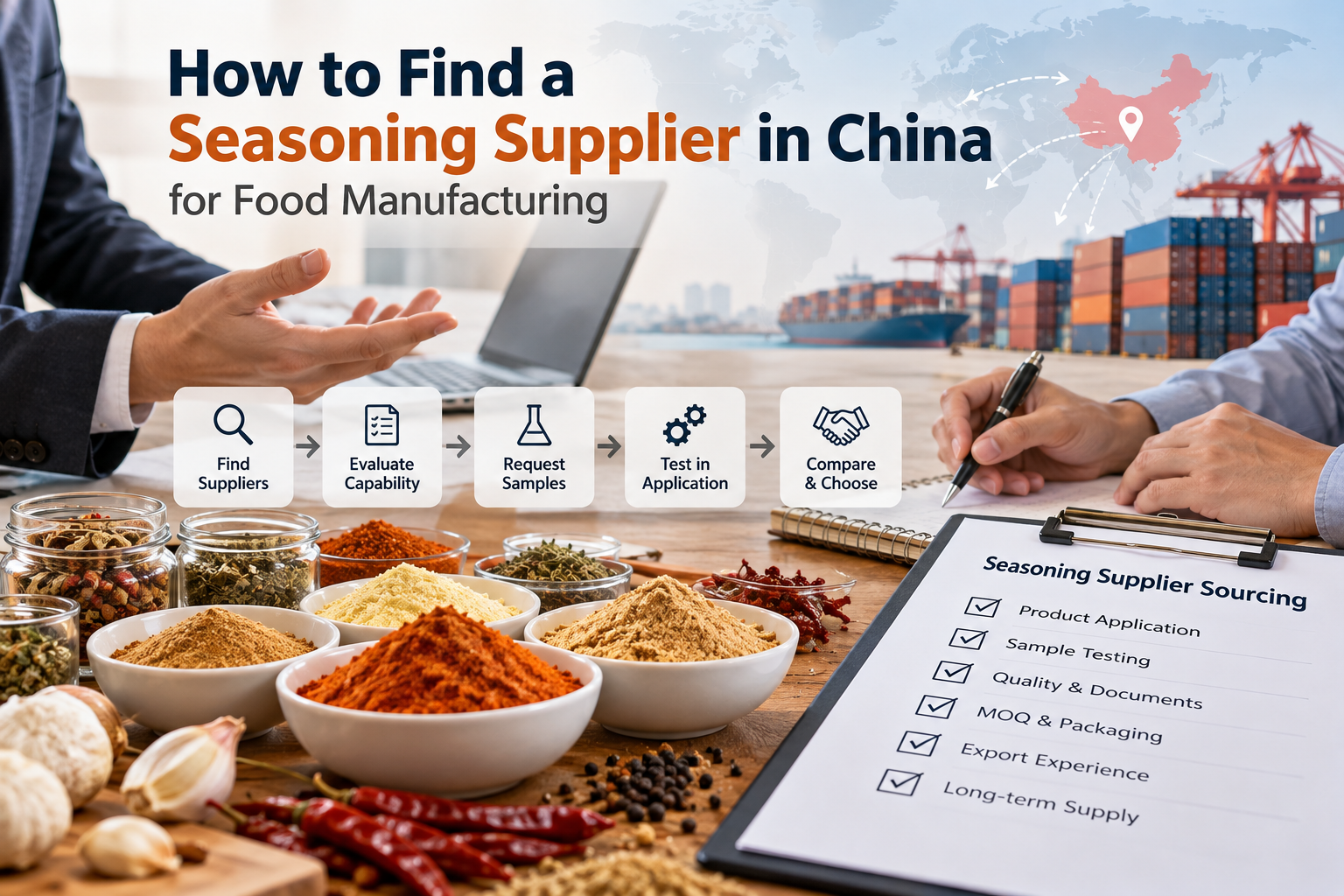
Finding a seasoning supplier in China is relatively easy. Finding the right seasoning supplier for a specific food manufacturing project is much more difficult.
A search may return many companies offering chicken seasoning, beef seasoning, compound seasoning, bouillon, meat flavors, soup bases and other savory products. However, not every supplier is suitable for every application.
An instant noodle manufacturer, processed meat factory, sauce producer and bouillon manufacturer may all be looking for “seasoning,” but the technical requirements, sample evaluation methods and supplier capabilities can be very different.
This guide explains how food manufacturers can find, screen, test and compare seasoning suppliers in China before moving toward commercial purchasing.
If you are still building an initial supplier list, you can also review our guide to seasoning manufacturers in China.
Start with the Food Product, Not the Supplier Name
One of the biggest sourcing mistakes is starting with a broad search such as “seasoning factory China” without first defining what the finished food actually needs.
Before contacting suppliers, buyers should clarify the application.
- What finished food are you producing?
- What flavor profile are you trying to achieve?
- Is the seasoning used as the main taste system or only for flavor adjustment?
- Will the product be boiled, fried, baked, sterilized, frozen or reheated?
- Do you already have a formulation?
- Do you have a benchmark product?
- What problem are you trying to solve?
These questions help determine what type of supplier should be contacted.
A supplier specializing in meat seasoning may be more suitable for sausages and meatballs, while another supplier may be stronger in noodles, bouillon, sauces or snack seasoning.
What Type of Seasoning Supplier Do You Need?
“Seasoning supplier” can refer to several different types of companies.
Depending on the project, buyers may encounter:
- compound seasoning manufacturers;
- meat seasoning manufacturers;
- chicken or beef seasoning suppliers;
- bouillon seasoning manufacturers;
- savory flavor suppliers;
- sauce seasoning suppliers;
- food flavor manufacturers;
- ingredient distributors;
- trading companies;
- and application-oriented seasoning developers.
The right choice depends on whether the project needs a complete seasoning system, a specific flavor component, a standard product or a customized solution.
Where Can You Find Seasoning Suppliers in China?
B2B buyers can use several channels to build an initial supplier list.
1. Google Search
Google is useful for identifying manufacturers that already publish information about their products, applications and export capabilities.
Instead of searching only for “seasoning supplier China,” use more specific combinations such as:
- chicken seasoning manufacturer China;
- beef seasoning supplier China;
- processed meat seasoning manufacturer China;
- bouillon seasoning supplier China;
- savory seasoning manufacturer China;
- custom seasoning manufacturer China;
- mayonnaise seasoning supplier China;
- food seasoning supplier for instant noodles.
Specific searches usually produce more relevant results than a general seasoning search.
2. B2B Marketplaces
B2B platforms can provide a large number of supplier candidates quickly.
However, buyers should not assume that every listed seller is the actual manufacturer.
Marketplace information can be useful for building a shortlist, but company identity, manufacturing capability, product ownership and technical support should still be verified separately.
3. Trade Shows and Food Ingredient Exhibitions
Ingredient and food manufacturing exhibitions can be useful when buyers want to meet several suppliers in a short period.
Trade shows can also help buyers understand how suppliers position themselves across categories such as compound seasoning, food flavors, meat ingredients, bouillon, sauces and savory systems.
However, exhibition participation alone does not prove that a supplier is suitable for a specific formulation.
4. Industry Referrals
Referrals from food factories, importers, distributors or technical professionals can help identify suppliers with experience in particular applications.
However, a supplier that works well for one factory may not necessarily be the best choice for another product category or target market.
Manufacturer or Trading Company: Which Is Better?
Food buyers often ask whether they should work directly with a manufacturer or through a trading company.
There is no universal answer.
A manufacturer may provide more direct access to production, technical communication and product development.
A trading company may offer broader product sourcing, communication support or consolidation of multiple products.
The more important question is whether the supplier can provide the product, documentation, sample support and commercial reliability required by the project.
Buyers should verify the actual role of the company before assuming that “factory” automatically means better or that “trader” automatically means worse.
Check Whether the Supplier Understands Your Application
Product application experience is one of the most important factors when selecting a seasoning supplier.
A supplier that understands the final food can usually ask more useful questions during the sample stage.
For example, a processed meat project may require information about:
- meat species;
- fat level;
- water content;
- heating temperature;
- processing time;
- spice system;
- target meat character;
- and finished eating profile.
A noodle seasoning project may instead require information about soup dilution, oil sachets, salt level, broth direction and preparation method.
A sauce project may require information about acidity, sugar, oil, egg, spices, emulsification and benchmark profile.
The questions a supplier asks can reveal a lot about whether the company understands the application.
Choose Suppliers According to Product Category
If the project is already clearly defined, category-specific supplier research can save time.
For chicken applications, buyers can review our guide to chicken seasoning manufacturers in China.
For beef applications, see our comparison of beef seasoning manufacturers in China.
For sausages, meatballs and other industrial meat applications, our guide to processed meat seasoning manufacturers in China provides a more specialized starting point.
For broader savory applications such as noodles, soup, broth, sauces and prepared foods, buyers can review savory seasoning manufacturers in China.
Check Whether the Supplier Offers the Right Type of Product
Different products may sound similar but perform different roles in a food formulation.
For example:
- Chicken seasoning powder may provide a broader seasoning structure.
- Chicken flavor powder may focus more strongly on chicken flavor expression.
- Beef seasoning powder and beef flavor powder may serve different formulation purposes.
- A meat flavor enhancer may strengthen meat perception and savory body without replacing the complete seasoning system.
- A mayonnaise seasoning system is different from finished mayonnaise or a single mayonnaise flavor.
Buyers should therefore ask what role each product is designed to play.
If you are comparing broader ingredient roles, our article on flavor base vs. seasoning powder explains why these products should not automatically be treated as interchangeable.
Standard Seasoning or Customized Formula?
Some food manufacturers only need a standard product that already fits their application.
Others require customization because the target product has a specific regional taste, benchmark, processing condition or cost structure.
Customization may be useful when:
- the existing sample is close but not exact;
- the target market requires a different flavor profile;
- the current seasoning becomes weak after heating;
- the buyer has a benchmark product;
- the finished food uses an unusual formulation;
- or the manufacturer is developing a new product from the beginning.
Buyers should confirm the supplier’s actual customization capability instead of assuming that every seasoning company can develop a new formula.
What Information Should You Send Before Requesting Samples?
The quality of the information provided by the buyer can directly affect the relevance of the samples received.
A useful sample request may include:
- finished product type;
- target country or market;
- desired flavor direction;
- processing method;
- current formulation, when appropriate;
- benchmark product, if available;
- main sensory problem;
- expected purchasing volume;
- packaging requirements;
- and certification or technical document requirements.
For example, “We need chicken seasoning” provides very little information.
“We manufacture instant noodles for the Southeast Asian market and need a chicken broth seasoning with a fuller body and stronger cooked chicken character after dilution” gives the supplier a much clearer direction.
Use a Benchmark When Possible
A benchmark can make communication much more efficient.
The benchmark may be:
- a competitor product;
- the buyer’s current finished food;
- an existing seasoning;
- a retail product;
- or a reference flavor profile.
The objective does not always need to be an exact copy.
A buyer may simply want a similar direction with stronger meat character, lighter saltiness, longer aftertaste, lower sweetness or a different regional style.
Clear benchmark feedback helps reduce unnecessary sample rounds.
Do Not Judge a Seasoning Only by Smelling the Dry Powder
A seasoning should usually be evaluated in the actual food application.
Dry powder aroma can be very different from finished performance.
Flavor may change after contact with:
- water;
- fat;
- protein;
- starch;
- salt;
- sugar;
- spices;
- acids;
- and other ingredients.
Heating, frying, boiling, sterilization, freezing and storage may also affect the final sensory result.
This is why application testing is much more useful than comparing dry samples only.
Test All Suppliers Under the Same Conditions
When comparing samples from several suppliers, use the same base formulation and processing method whenever possible.
Otherwise, it becomes difficult to determine whether differences come from the seasoning or from the test conditions.
Buyers may compare:
- target flavor accuracy;
- savory and umami intensity;
- meat or broth character;
- salt balance;
- spice integration;
- performance after heating;
- aftertaste;
- off-notes;
- overall flavor body;
- and similarity to the benchmark.
Give Specific Feedback After Sample Testing
Good feedback helps the supplier understand what should be changed.
Instead of saying:
“The sample is not strong enough.”
buyers can give more specific feedback such as:
“The chicken aroma is acceptable, but the broth body is too light and the flavor becomes weak after dilution.”
Or:
“The meat character is good, but the aftertaste is too short and the spice profile is too dominant.”
This kind of feedback makes the next sample round much more useful.
Evaluate Communication Quality
Supplier communication is also part of the sourcing process.
A good supplier does not necessarily need to answer every technical question immediately, but communication should be clear and consistent.
Buyers may consider whether the supplier:
- understands the application;
- asks relevant questions;
- explains product differences clearly;
- avoids unsupported claims;
- can organize sample discussions;
- and responds to commercial questions in a structured way.
Poor communication during the sample stage can become a larger problem after commercial orders begin.
Check Product and Technical Documentation
Before commercial ordering, buyers should confirm what documentation is available for the specific product.
Depending on the market and project, relevant documents may include:
- product specification;
- ingredient information;
- certificate of analysis;
- safety or technical documents;
- allergen information;
- certification documents;
- and export-related documentation.
The exact documentation available varies by supplier and product.
Buyers should not assume that every product from the same company has identical documentation or certification coverage.
How to Check Halal Requirements
Halal requirements should be confirmed at the product level when they are important for the target market.
Useful points to verify may include:
- the specific product covered;
- certificate holder;
- manufacturing site;
- certificate validity;
- certification body;
- and whether the certificate is accepted in the destination market.
A company holding a Halal certificate does not automatically mean that every seasoning it sells is covered by that certificate.
Compare MOQ, Packaging and Commercial Conditions
Price is important, but it should not be compared in isolation.
Buyers should also confirm:
- minimum order quantity;
- packaging options;
- sample policy;
- production lead time;
- payment terms;
- shipping arrangements;
- export documentation;
- and whether customization affects MOQ or commercial terms.
These conditions vary significantly by product and supplier and should always be confirmed for the actual project.
Do Not Choose the Lowest Price Before Application Testing
A lower price per kilogram does not automatically mean a lower cost in the finished food.
Two seasonings may have different flavor intensity, dosage requirements, processing stability and final sensory performance.
A cheaper product that requires significantly more usage or fails to meet the target profile may not be the better commercial choice.
For this reason, buyers should evaluate both sensory performance and overall formulation economics.
Check Whether the Supplier Can Support Repeat Orders
Commercial sourcing does not end after the first successful sample.
Food manufacturers also need to consider whether the supplier can support repeat purchasing with acceptable consistency.
Questions may include:
- Can the same product be supplied consistently?
- How are product changes communicated?
- Can the supplier support recurring export orders?
- Are packaging and documents stable between shipments?
- Can the supplier continue supporting application adjustments when needed?
Consistency becomes especially important when the seasoning directly affects the signature flavor of the finished food.
How Many Suppliers Should You Compare?
There is no fixed number, but buyers usually benefit from comparing more than one qualified supplier before making a decision.
The objective is not to collect as many quotations as possible.
A smaller shortlist of suppliers that actually understand the application is often more useful than dozens of generic quotations.
A practical process may be:
- Build an initial supplier list.
- Remove companies that do not match the application.
- Discuss the project with several qualified suppliers.
- Request relevant samples.
- Test samples under consistent conditions.
- Compare technical, commercial and communication performance.
- Select the supplier that best matches the complete project.
How to Screen a Chinese Seasoning Supplier Before Ordering
Before placing a commercial order, buyers may want to verify basic company and supply information.
Depending on the project, this can include:
- company identity;
- manufacturing or sourcing role;
- actual product capability;
- technical documents;
- sample consistency;
- export experience;
- commercial terms;
- and required certification.
Supplier screening should be proportional to the order size, market requirements and importance of the ingredient.
How to Choose Between Several Qualified Suppliers
After sample testing, buyers may still have two or three acceptable suppliers.
At this stage, the decision should consider the complete relationship rather than only the sample taste.
Useful comparison points may include:
- application fit;
- sample performance;
- ability to adjust the product;
- technical communication;
- documentation;
- commercial conditions;
- order consistency;
- and long-term sourcing reliability.
For more supplier-selection considerations, read our guide on how to choose a savory flavor supplier in China.
Example of a Better Seasoning Supplier Inquiry
A useful inquiry might look like this:
We manufacture [finished product] for the [country/market] market and are looking for a [chicken / beef / meat / broth / savory / sauce] seasoning. Our processing method is [process], and our target flavor is [description]. We currently have [benchmark/current product] and would like to improve [specific issue]. Our estimated purchasing volume is [quantity]. Please advise suitable products, sample availability, packaging, MOQ, available documents and commercial terms.
This gives the supplier enough information to recommend a more relevant starting point.
What Should You Avoid When Sourcing Seasoning from China?
Common sourcing mistakes include:
- asking only for the lowest price;
- requesting samples without explaining the application;
- choosing a product based only on dry powder aroma;
- assuming every seasoning with a similar name performs the same function;
- assuming company-level certification covers every product;
- comparing samples under different test conditions;
- ignoring processing performance;
- and failing to confirm commercial conditions before final approval.
A structured sourcing process can reduce many of these problems.
A Simple Seasoning Supplier Sourcing Process
For most commercial food projects, the sourcing process can be summarized as:
Define the finished product → identify the seasoning function → find relevant suppliers → screen application capability → discuss the target flavor → request samples → test in the actual food → provide specific feedback → confirm documentation and commercial terms → place the commercial order.
This process is usually more effective than searching only for the “best” or “cheapest” seasoning manufacturer.
Looking for a Seasoning Supplier in China?
ZXS Flavors works with seasoning and savory flavor solutions for commercial food manufacturing.
Current sourcing directions include chicken seasoning, beef seasoning, processed meat seasoning, bouillon seasoning, chicken and beef flavor powders, savory meat flavor enhancement, mayonnaise seasoning systems and other compound savory applications.
If you are looking for a seasoning supplier in China, send us your finished product type, target market, processing method, target flavor, benchmark and sample requirements.
We can review the application and discuss suitable product directions according to the actual project and available supply source.
Contact ZXS Flavors to discuss your seasoning sourcing project, request product information or arrange sample evaluation.