
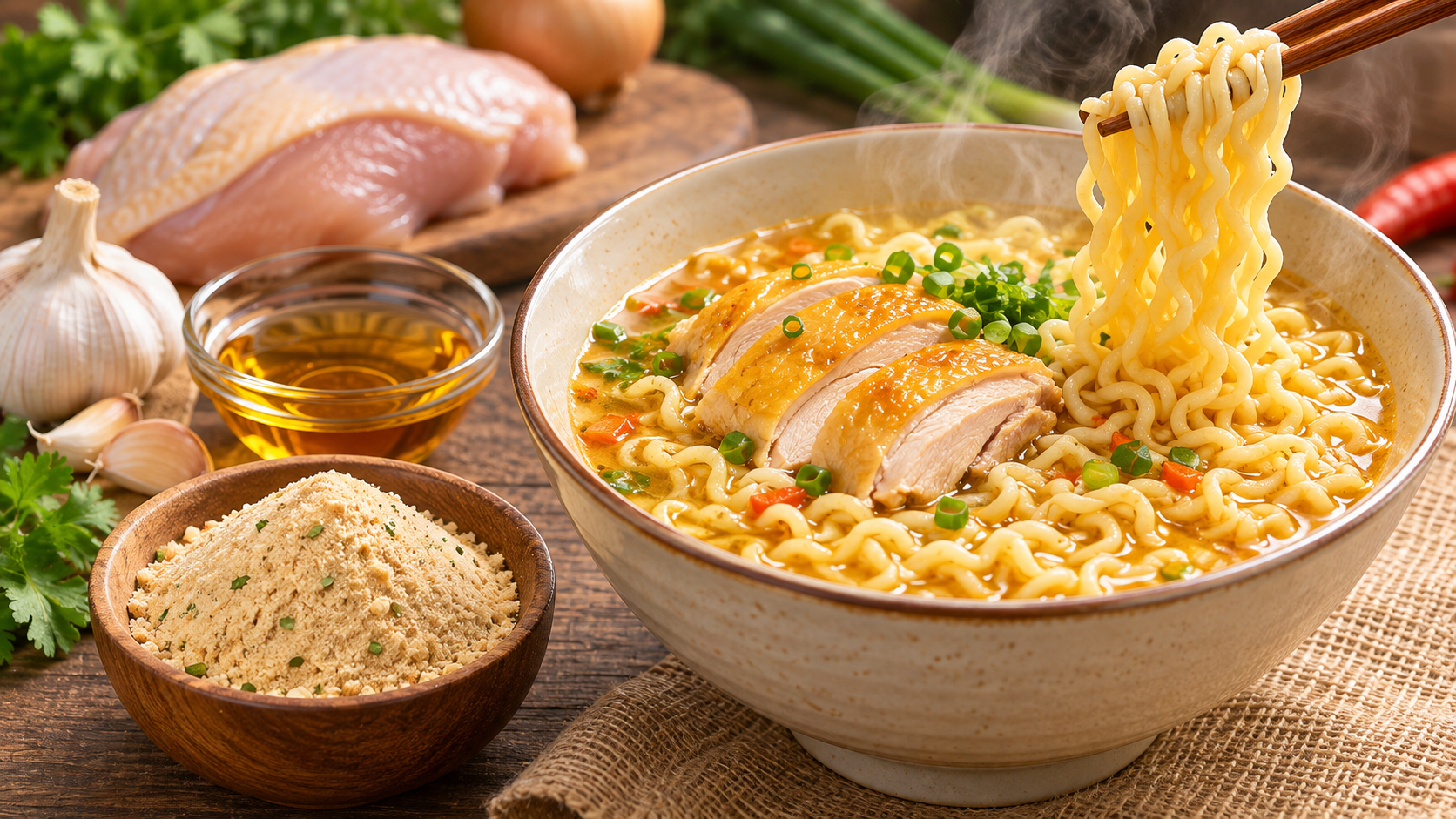
Developing a chicken-flavored instant noodle product requires more than choosing a strong chicken flavor. Manufacturers need a complete seasoning system that delivers the intended chicken taste, savory depth, salt balance, spice profile and aroma after the noodles are prepared according to the package instructions.
The right solution may use seasoning powder alone or a combination of powder and seasoning oil. In some applications, savory bases, umami ingredients and selected flavor components can help achieve the target profile. The important point is to design these elements around the finished noodle product, not around a single ingredient.
This guide explains how food manufacturers can develop a complete chicken seasoning system for instant noodles, from the target broth profile to sample testing, processing requirements and cost evaluation.
1. Start with the Finished Instant Noodle Product
Before selecting seasoning ingredients, define exactly what the customer will prepare and eat.
Important questions include:
- Is the product a soup noodle, dry noodle or mixed noodle?
- Will it be packaged in a cup, bowl or bag?
- Are the noodles fried or non-fried?
- How much water will consumers add?
- Will the seasoning be mixed with hot water, cooked in a pot or stirred directly into drained noodles?
- What chicken taste is expected in the target market?
- What is the cost target per finished serving?
A light chicken broth for cup noodles may require a different seasoning approach from a rich, oily chicken soup or a spicy chicken-style dry noodle.
This is why seasoning development should begin with the finished food format and preparation method.
2. Define the Target Chicken Broth Profile
Chicken seasoning is not one fixed sensory profile. Different noodle products may require different balances of taste and aroma.
Common development directions include:
- Light chicken broth: A relatively clean, mild chicken character with balanced saltiness and a lighter savory finish.
- Rich chicken broth: A fuller chicken taste with more savory body and a longer-lasting finish.
- Roasted chicken: A chicken profile supported by suitable roasted or browned notes.
- Chicken and vegetable: Chicken taste balanced with onion, garlic, vegetable or herbal notes.
- Spicy chicken: Chicken character combined with chili, pepper and other spices without allowing heat to overwhelm the broth.
These are formulation directions, not fixed recipes. The final profile should be based on the customer’s product concept, benchmark sample and target market.
3. Build the Complete Chicken Seasoning Structure
A complete chicken noodle seasoning system may combine several functions. Not every formulation needs every component, and some functions may already be integrated into a single compound seasoning.
| Seasoning Function | Purpose in the Finished Noodles |
|---|---|
| Compound seasoning | Coordinates salt, spices, savory taste and the overall chicken seasoning profile. |
| Chicken taste foundation | Provides the main chicken-style identity and supports the broth character. |
| Savory base | Helps build depth, fullness and continuity of taste where required. |
| Umami ingredients | Support savory intensity and the overall taste balance. |
| Spices and vegetables | Define garlic, onion, pepper, chili and other supporting characteristics. |
| Seasoning oil | Can contribute aroma, richness and a different flavor experience where suitable. |
| Reaction flavor or other flavor components | Optional technical ingredients for specific cooked, roasted or aroma characteristics. |
The objective is not to add as many components as possible. It is to achieve the required sensory result with an efficient, manageable seasoning system.
Manufacturers looking for customized application products can review our Noodle Seasoning and Chicken Seasoning Blend directions.
4. Seasoning Powder, Seasoning Oil or Both?
The choice of seasoning format affects product development, packaging, consumer preparation and cost.
Powder-Based Chicken Seasoning
A powder-based system may be suitable when the product requires a convenient dry seasoning sachet and a broth profile that can be developed primarily through dry ingredients.
Manufacturers should evaluate solubility or dispersion, salt balance, powder flow, moisture sensitivity and the finished taste at the intended water volume.
Powder Plus Seasoning Oil
A separate seasoning oil sachet may be useful when the product concept calls for oil-associated aroma, richness or selected spice and roasted notes.
However, adding an oil sachet also affects packaging requirements, filling operations, ingredient compatibility, cost and storage evaluation.
Oil is not automatically necessary for a good chicken noodle product. It should be included because it improves the target eating experience, not simply because competing products use it.
Integrated Compound Seasoning
Some manufacturers prefer a more integrated compound seasoning to reduce the number of separately weighed or packed ingredients. Others prefer separate powder and oil components for greater control over the finished profile.
Both approaches can be valid. The decision should reflect the actual product and production line.
5. Balance Chicken Taste, Umami and Savory Body
A chicken noodle soup can have a recognizable chicken aroma but still taste weak during eating. Another formulation may have strong umami and saltiness but lack a convincing chicken identity.
These are different formulation problems.
- Weak chicken identity: Review the main chicken-style seasoning foundation.
- Thin broth: Evaluate the broader savory structure and appropriate base ingredients.
- Short aftertaste: Assess the overall balance after swallowing instead of only the first aroma impact.
- Excessive saltiness: Review the complete seasoning system rather than assuming more savory intensity requires more salt.
- Overpowering spices: Rebalance garlic, pepper, chili or other spices against the intended chicken character.
Our Savory Flavor Base is one example of a supporting component that can be considered where broader savory depth is required.
Reaction flavor may also be considered for a specific roasted or cooked direction, but it is only one possible component. It should not be the starting point for every chicken seasoning project.
6. Consider the Noodles and Preparation Method
The final seasoning result depends on more than the contents of the sachet.
The noodle block, its surface oil, the amount of cooking or soaking water, preparation temperature and the time before eating can all change how consumers perceive the finished product.
For example, seasoning developed in plain hot water may taste different once the actual noodle block is added.
Manufacturers should therefore test the seasoning with:
- the intended noodle type;
- the correct water volume;
- the actual preparation instructions;
- the complete seasoning sachets;
- and the intended serving conditions.
The approved reference should be the finished bowl of noodles, not an isolated seasoning sample.
7. Test the Broth After Preparation
For soup-style instant noodles, broth performance is a major part of the consumer experience.
A practical sensory evaluation can include:
- chicken character in the prepared broth;
- saltiness at the intended dilution;
- umami and savory depth;
- garlic, onion and other spice balance;
- aroma when the package is first prepared;
- taste after the noodles have absorbed some liquid;
- overall mouthfeel;
- and the aftertaste after eating.
For dry or mixed noodles, evaluation should focus more on flavor distribution, coating, oil balance and taste on the actual noodle strands.
Different product formats require different sensory tests.
8. Compare Samples Fairly
A useful sample comparison keeps the noodle base and preparation conditions consistent.
For example, an R&D team may compare two seasoning directions while keeping the following unchanged:
- noodle block and weight;
- water volume;
- preparation method;
- serving conditions;
- and the sensory evaluation criteria.
If one sample uses powder only and another uses powder plus oil, the comparison should evaluate the complete finished serving. It should not rely only on the price or weight of the powder sachet.
Where possible, identify the main reason for any improvement before making further adjustments.
9. Evaluate Cost per Serving, Not Only Ingredient Price
For instant noodle manufacturers, cost control is an important development requirement. However, a lower seasoning price per kilogram does not always mean a lower cost for the finished noodle product.
A more useful comparison considers:
- the tested amount of each seasoning component per serving;
- ingredient price and supply conditions;
- the number and type of sachets;
- packaging and filling requirements;
- additional ingredients needed to reach the target taste;
- and the final sensory performance.
The ingredient cost per serving can be calculated from the actual amount used and its unit purchase price. Packaging and processing costs should then be evaluated separately as part of the total finished-product cost.
Final dosage, packaging format and commercial cost should be confirmed through the customer’s own formulation and production trials.
10. Check Production and Storage Compatibility
A seasoning system that performs well during initial development still needs to fit the commercial manufacturing process.
Depending on the format, manufacturers may need to evaluate:
- powder handling and flowability;
- moisture exposure and clumping;
- uniformity during mixing and filling;
- oil stability and packaging compatibility;
- aroma changes during storage;
- batch-to-batch sensory consistency;
- and the applicable labeling, allergen and ingredient requirements of the destination market.
These factors should be confirmed by appropriate product testing. A seasoning concept should not be assumed to meet a particular shelf life or market requirement without verification.
11. What Should Manufacturers Send to a Seasoning Supplier?
A clear development brief helps the seasoning supplier recommend a more suitable solution and reduces unnecessary sample rounds.
Useful information includes:
- Finished food: Chicken soup noodles, cup noodles, dry noodles or another format.
- Target taste: Light broth, rich chicken, roasted chicken, spicy chicken or another direction.
- Current problem: Weak chicken taste, thin broth, excessive salt, short aftertaste or another issue.
- Seasoning format: Powder, oil, paste or a combination.
- Preparation method: Noodle type, water volume and consumer instructions.
- Reference product: An approved sample, competitor benchmark or written sensory target.
- Commercial requirements: Target market, cost objective, trial quantity and expected usage.
The more clearly the finished application is defined, the easier it becomes to choose between a complete compound seasoning and separate supporting components.
12. Develop the Chicken Seasoning Around the Finished Food
The most effective starting question is not “Which chicken flavor is strongest?” but “What chicken noodle product are we trying to make?”
A successful development process connects the desired broth or noodle taste with the appropriate compound seasoning structure, powder and oil format, application testing, production method and cost target.
Zhongxinsheng Flavor Co., Ltd. provides customizable compound seasoning and savory seasoning solutions for food manufacturers. Our existing Noodle Seasoning and Chicken Seasoning Blend directions can serve as starting points for discussing chicken-flavored instant noodle applications.
If you are developing or improving a chicken instant noodle product, contact Zhongxinsheng Flavor with your noodle format, target chicken profile, preferred seasoning format, preparation instructions and current formulation challenge to discuss suitable sample development options.