
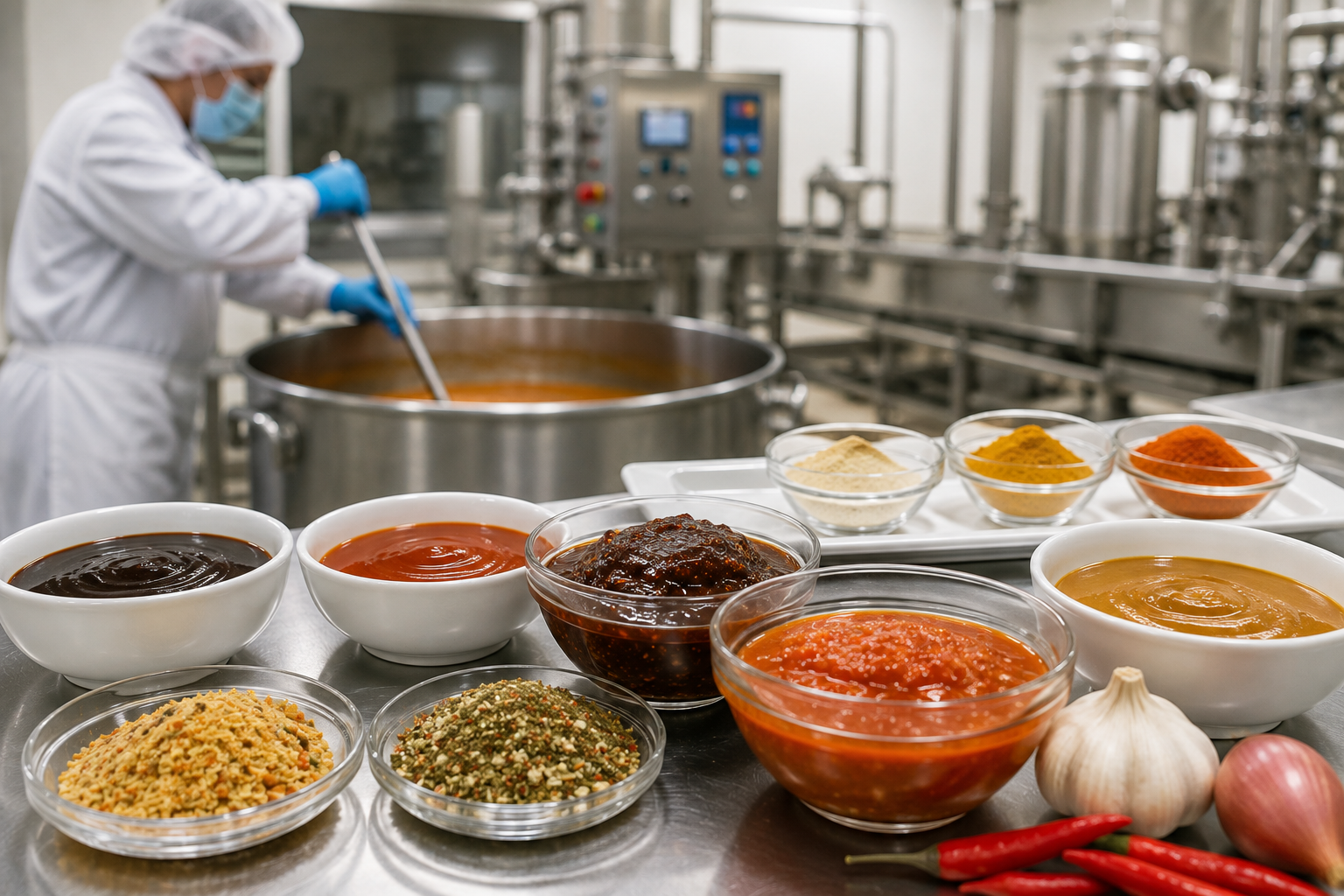
Sauce products play an important role in many Southeast Asian food categories, from dipping sauces and cooking sauces to instant food seasonings and prepared food applications.
For food manufacturers, developing the right sauce seasoning involves more than creating a strong flavor. The seasoning must work together with the sauce base, processing conditions, target market preferences and final food application.
This guide explains the key factors Southeast Asia food manufacturers should consider when developing sauce seasoning and working with a seasoning supplier.
What Is Sauce Seasoning?
Sauce seasoning is a compound seasoning solution developed to support the overall flavor profile of sauces and related food applications.
Depending on the product, a sauce seasoning may help build savory depth, aroma, spice intensity, saltiness, sweetness balance and overall flavor impact.
Unlike a single ingredient, a customized seasoning system is developed around the requirements of the finished food product.
Food manufacturers looking for broader seasoning solutions can also explore our Seasoning Blends and Application Seasonings.
1. Start with the Final Sauce Application
The first step in sauce seasoning development is understanding how the finished sauce will be used.
Different applications may require very different flavor structures.
Typical sauce applications may include:
- Dipping sauces
- Cooking sauces
- Marinades
- Stir-fry sauces
- Noodle sauces
- Meat sauces
- Snack sauces
- Prepared food sauces
A seasoning developed for a dipping sauce may not perform the same way in a sauce that is heated during cooking or mixed into another food product.
For this reason, manufacturers should evaluate seasoning according to the actual application rather than selecting only by flavor name.
2. Build the Right Savory Flavor Balance
Savory flavor is often one of the most important parts of a commercial sauce formulation.
However, stronger savory taste does not automatically mean better flavor.
The seasoning should support the overall sauce profile and create balance between different sensory characteristics.
Food manufacturers may evaluate:
- Initial flavor impact
- Savory depth
- Saltiness
- Sweetness
- Spice intensity
- Aroma
- Aftertaste
For applications requiring additional savory depth or meat-style characteristics, manufacturers may also consider customized Flavor Bases as part of the overall flavor system.
3. Consider Southeast Asian Market Preferences
Southeast Asia is not a single flavor market.
Consumer preferences may differ by country, food category and target customer group.
Depending on the market, manufacturers may require different levels of:
- Spiciness
- Savory intensity
- Sweetness
- Saltiness
- Garlic or onion aroma
- Roasted notes
- Meat-style flavor
- Lingering aftertaste
This means that a standard sauce seasoning formula may not be suitable for every Southeast Asian market.
Customized flavor development allows manufacturers to adjust the seasoning according to their target market and finished product positioning.
4. Evaluate the Effect of Heat and Processing
Processing conditions can significantly affect how a sauce seasoning performs.
During commercial production, a sauce may be exposed to heating, mixing, dilution or storage before reaching the consumer.
Manufacturers should consider factors such as:
- Cooking temperature
- Heating time
- Moisture level
- Oil content
- Dilution ratio
- Mixing process
- Finished product storage conditions
Some aroma characteristics may become weaker after heating, while other flavor notes may become more noticeable.
For this reason, seasoning evaluation should be carried out in the real sauce system whenever possible.
5. Match the Seasoning with the Sauce Base
The sauce base itself has a major influence on the finished flavor.
Oil, sugar, salt, chili, tomato, fermented ingredients and other components can all change the way a seasoning is perceived.
A seasoning that tastes balanced in water may perform very differently in an oil-rich or strongly flavored sauce.
Manufacturers should therefore develop the seasoning together with the actual sauce formulation rather than treating the seasoning as an isolated component.
6. Customization Is Important for Industrial Applications
For food manufacturers, standard seasoning products can be useful during early evaluation, but commercial development often requires further adjustment.
Sauce seasoning can be customized according to factors such as:
- Target flavor direction
- Food application
- Regional taste preference
- Processing conditions
- Desired flavor intensity
- Finished product positioning
Customization can help manufacturers develop a flavor profile that better matches their product concept instead of relying on a general-purpose seasoning.
7. Test the Seasoning in the Finished Product
Sample evaluation is an important stage of sauce seasoning development.
Manufacturers should avoid evaluating only the dry seasoning powder.
A more useful process is to test the seasoning directly in the intended sauce formulation.
During testing, food manufacturers can compare:
- Flavor impact before and after processing
- Aroma performance
- Savory depth
- Spice balance
- Aftertaste
- Overall compatibility with the sauce base
Feedback from application testing can then be used to further adjust the seasoning profile.
8. Consider Production Consistency
Consistency is important when a sauce moves from product development into commercial production.
Food manufacturers need a seasoning solution that can support a stable finished flavor across production batches.
When evaluating a supplier, buyers should discuss how product requirements, formulation adjustments and production consistency will be managed.
Any final specifications should be confirmed according to the agreed product and cooperation requirements.
9. Confirm Regulatory and Documentation Requirements
Food regulations and documentation requirements can vary between Southeast Asian markets.
Before commercial production, manufacturers and importers should confirm the requirements of the destination market.
Depending on the country and product category, buyers may need to review:
- Ingredient information
- Product documentation
- Labeling requirements
- Import requirements
- Market-specific compliance requirements
If specific certifications or documentation are required, these should be confirmed with the supplier before placing a commercial order.
10. Work with a Supplier That Understands Food Applications
A sauce seasoning supplier should understand more than flavor names.
For industrial food development, effective cooperation requires an understanding of the finished product, processing conditions and target market.
A B2B seasoning partner may support customers through:
- Flavor profile discussion
- Application-oriented seasoning development
- Sample evaluation
- Flavor adjustment
- Product development communication
This application-focused approach is especially important for manufacturers developing products for different Southeast Asian markets.
Working with a China Sauce Seasoning Supplier
China is an important sourcing market for compound seasonings and savory flavor solutions.
For Southeast Asia food manufacturers, the key is not simply finding a supplier with a large product catalog, but finding a partner that can understand the intended food application and adjust the flavor solution accordingly.
Zhongxinsheng Flavor Co., Ltd. provides compound seasonings, application seasonings and savory flavor solutions for food manufacturers, importers and distributors.
Flavor profiles can be customized according to application requirements and customer development needs, subject to final product confirmation.
Explore our seasoning and flavor products to learn more about our product directions.
Conclusion
Choosing the right sauce seasoning requires a combination of flavor development and application testing.
For Southeast Asia food manufacturers, important factors include the final sauce application, regional taste preferences, savory balance, processing conditions, customization requirements and production consistency.
By evaluating seasoning directly in the finished sauce and working closely with an application-oriented supplier, manufacturers can develop flavor solutions that better match their products and target markets.