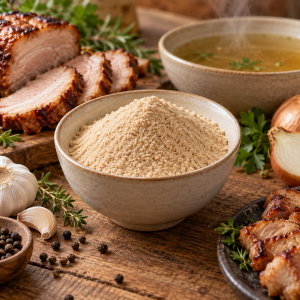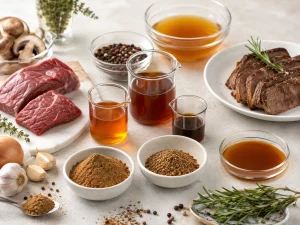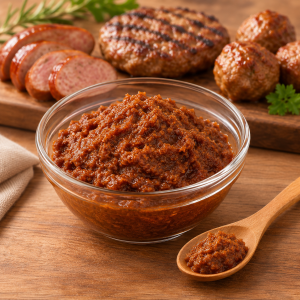
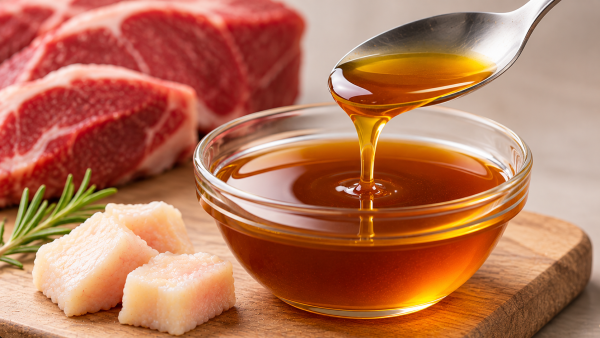
Beef Fat Flavor Base is a customizable savory flavor base developed for food manufacturers that need a richer fatty beef character, deeper meat-style body and a more complete beef flavor foundation in finished food products.
This product direction is designed for applications where general beef aroma alone is not enough. In many meat products, sauces, noodles, soups and prepared foods, the finished profile may also need the sensory impression associated with beef fat, cooked meat richness and savory depth.
The objective is not simply to make the product taste “more fatty.” The flavor base should support the overall beef profile and work together with seasoning, reaction flavors, umami and other savory components.
Recommended dosage should be confirmed according to the application, formulation and target flavor profile.
What Is Beef Fat Flavor Base?
Beef Fat Flavor Base is a beef-style flavor base developed around richer fatty, meaty and savory characteristics.
Depending on the target application, the flavor direction may be adjusted toward characteristics such as:
- fatty beef character;
- rendered beef fat-style notes;
- rich cooked beef perception;
- meaty body and savory depth;
- broth richness;
- rounder beef mouthfeel;
- or a customized beef fat-style profile for a specific finished food.
The final sensory direction should be confirmed according to the customer’s actual food application, processing conditions and target product.
Why Some Beef Products Need More Than Beef Aroma
A product can have a recognizable beef aroma but still taste thin.
This is particularly relevant in applications such as sauces, instant noodles, soup bases, meat fillings and prepared foods where the overall beef impression depends on more than the first aroma.
A complete beef profile may need several layers:
- beef identity for recognizable meat direction;
- fatty beef character for richness and roundness;
- reaction flavor for cooked, roasted or grilled notes;
- savory body for depth and continuity;
- umami for overall taste support;
- seasoning balance for salt, spices, sweetness and final flavor structure.
Beef Fat Flavor Base can be evaluated when the formulation already has beef aroma but still lacks the richer meat-fat style foundation required by the finished product.
Beef Fat Flavor Base vs. Beef Flavor Base
Zhongxinsheng already provides a broader Beef Flavor Base for food manufacturers developing beef-flavored products, soups, sauces and seasoning systems.
Beef Fat Flavor Base is intended as a more specific development direction.
| Product Direction | Main Development Focus |
|---|---|
| Beef Flavor Base | Overall beef foundation, savory depth, beef identity and general richness |
| Beef Fat Flavor Base | Fatty beef character, richer meat-fat perception, roundness and deeper beef body |
The two directions are related, but they are not necessarily identical.
The appropriate choice should depend on the finished application and the specific sensory gap that the manufacturer is trying to solve.
Beef Fat Flavor Base vs. Beef Reaction Flavor
Beef Reaction Flavor and Beef Fat Flavor Base can play different roles in the same savory system.
Beef Reaction Flavor is more focused on cooked, roasted, grilled and thermal beef characteristics.
Beef Fat Flavor Base is more focused on the underlying richness, fatty beef character and meat-style body.
| Product Type | Main Role |
|---|---|
| Beef Fat Flavor Base | Fatty beef character, richness, body and beef flavor foundation |
| Beef Reaction Flavor | Cooked, roasted, grilled and thermal beef notes |
| Seasoning Blend | Overall balance of salt, spices, umami, aroma and final taste profile |
For some food products, manufacturers may evaluate these components together rather than expecting one flavor ingredient to provide every sensory function.
Typical Applications
Beef Fat Flavor Base can be evaluated in a range of industrial savory food applications, including:
- processed meat products;
- beef sausages;
- meatballs;
- burger patties;
- meat fillings;
- instant noodle seasoning;
- soups and broths;
- sauces and gravies;
- hot pot and cooking sauces;
- prepared foods;
- frozen foods;
- ready meals;
- and other savory applications requiring a richer beef profile.
The same flavor direction should not automatically be applied to every product. Fat content, moisture, salt, spices, heating conditions and other formulation factors can all influence the final sensory result.
For Processed Meat Products
Processed meat products may already contain real meat, salt, spices and other savory ingredients but still require a fuller beef profile.
Depending on the product, manufacturers may want to strengthen:
- fatty beef perception;
- overall beef richness;
- meaty body;
- savory depth;
- cooked beef character;
- or aftertaste.
Beef Fat Flavor Base can be evaluated as one component of the complete meat flavor system.
During application testing, manufacturers should compare the finished cooked product rather than only the raw meat mixture.
For Burger Patties
In burger applications, the target beef profile may include more than a simple beef aroma.
The finished product may need a combination of:
- beef identity;
- fatty richness;
- grilled or browned notes;
- savory body;
- salt and pepper balance;
- and sufficient flavor persistence after cooking.
In this type of application, Beef Fat Flavor Base can be evaluated for the underlying richness, while a suitable reaction flavor may support the cooked or grilled layer.
This makes it possible to develop the flavor system according to the actual sensory target instead of simply increasing the dosage of one beef flavor.
For Sausage and Meatball Applications
Sausage and meatball products can contain different levels of fat, water, starch, spices and meat protein.
These formulation differences can significantly change how beef flavor is perceived.
For example, a formulation may have sufficient seasoning but still feel thin in the middle of the flavor profile.
Another product may have enough body but lack a recognizable cooked beef direction.
Beef Fat Flavor Base should therefore be evaluated according to the specific sensory problem rather than used as an automatic replacement for other beef flavor components.
For Sauces and Gravies
Sauces can be challenging because oil, starch, sugar, salt, spices and other ingredients may influence the way beef aroma and richness are perceived.
Beef Fat Flavor Base can be evaluated in sauce systems where the manufacturer wants to build a fuller beef-style foundation.
Possible applications include:
- beef gravy;
- braised beef sauce;
- meat sauce;
- beef noodle sauce;
- hot pot sauce;
- cooking sauces;
- and prepared savory sauces.
The target may range from a mild beef-fat background to a stronger rich beef profile depending on the finished product.
Why Fatty Character and Greasiness Are Not the Same Thing
When developing a beef fat-style flavor, the objective should not simply be to create an excessively oily or heavy sensory impression.
A good flavor direction should support the perception of beef richness without making the overall product feel unbalanced.
R&D teams may evaluate:
- whether the fatty note supports the beef character;
- whether the profile feels too heavy;
- whether the savory body is sufficient;
- whether the flavor works with salt and spices;
- and whether the aftertaste remains appropriate.
This distinction is important because “fatty beef character” is part of the sensory profile, while actual greasiness is influenced by the complete food formulation.
For Instant Noodles
Beef instant noodles often require several layers of flavor.
A complete beef noodle profile may involve:
- beef aroma;
- broth body;
- fatty beef richness;
- umami;
- salt balance;
- spices;
- cooked or roasted beef character;
- and aftertaste.
Beef Fat Flavor Base can be evaluated when the soup or seasoning system has recognizable beef aroma but still lacks roundness or richness after preparation.
For products requiring stronger cooked or roasted characteristics, manufacturers may also evaluate Beef Reaction Flavor as another layer of the system.
For Soups and Broths
Soup and broth systems often depend heavily on flavor body and continuity.
A product may smell beefy when first prepared but become weak during drinking if the flavor foundation is not sufficiently developed.
In this type of application, manufacturers may evaluate:
- broth body;
- fatty beef character;
- umami;
- meaty depth;
- salt balance;
- aroma release;
- and aftertaste.
Beef Fat Flavor Base can be considered when the development target requires a richer beef foundation rather than simply a stronger top aroma.
For Ready Meals and Prepared Foods
Ready meals may contain meat, sauce, vegetables, starch, oil and other ingredients that compete with the beef profile.
In these complex formulations, the beef direction can become diluted or less recognizable.
Beef Fat Flavor Base can be evaluated in products such as:
- beef rice meals;
- beef pasta sauces;
- prepared beef dishes;
- frozen beef meals;
- meat fillings;
- and other ready-to-heat savory foods.
The final evaluation should be carried out after the complete heating or preparation process.
How Beef Fat Flavor Base Can Work with Savory Flavor Base
Savory Flavor Base is designed to provide a broader savory foundation across different food applications.
Beef Fat Flavor Base is more specifically focused on a beef-fat style direction.
Depending on the product, a manufacturer may need:
- a general savory foundation;
- a specific beef foundation;
- additional fatty beef character;
- stronger cooked beef notes;
- or a combination of several layers.
The best solution depends on the finished formulation and target sensory result.
Processing Conditions Can Change the Final Beef Profile
The flavor should be evaluated under processing conditions that reflect the commercial product.
Relevant factors may include:
- mixing;
- marination;
- cooking;
- frying;
- grilling;
- roasting;
- boiling;
- retort or other thermal processing where applicable;
- freezing;
- storage;
- and reheating.
Different food matrices may release aroma and flavor differently.
This is why application testing should be performed in the actual product whenever possible.
Fat Content of the Finished Food Matters
A flavor base may perform differently in a high-fat meat product compared with a low-fat soup or dry seasoning system.
The existing fat level of the finished formulation can influence the overall perception of richness and aroma.
Manufacturers should therefore avoid assuming that the same flavor profile and use level will perform identically across all applications.
Samples should be compared using consistent base formulations so that differences can be evaluated more accurately.
What Should Be Evaluated During Application Testing?
Food manufacturers can evaluate Beef Fat Flavor Base according to several sensory dimensions.
- beef identity;
- fatty beef character;
- overall richness;
- savory depth;
- meaty body;
- cooked beef impression;
- compatibility with spices;
- performance after heating;
- aftertaste;
- and overall similarity to the target product.
Testing should be carried out using the same formulation and processing conditions when comparing different sample directions.
A Practical Sample Evaluation Sequence
- Define the finished product. Confirm whether the application is processed meat, sauce, noodle seasoning, soup, ready meal or another savory food.
- Define the target beef profile. Decide whether the product needs general beef character, fatty richness, cooked beef notes, roasted character or a combination.
- Identify the current sensory gap. Determine whether the product is thin, lacks beef identity, lacks fatty richness or lacks cooked character.
- Prepare a consistent base formulation. Keep other major ingredients unchanged when comparing samples.
- Test the flavor base in the actual application.
- Run the intended production process.
- Evaluate the finished product. Compare aroma, beef character, richness, savory depth and aftertaste.
- Adjust the flavor direction according to feedback.
Do Not Judge Beef Fat Flavor Only from the Concentrated Sample
A concentrated sample can help identify the general direction, but it cannot fully predict the finished-product result.
The flavor may behave differently after being combined with:
- meat protein;
- oil or fat;
- water;
- salt;
- sugar;
- starch;
- spices;
- umami ingredients;
- and other flavor components.
The real reference point should therefore be the final food application.
Cost Evaluation Should Focus on Finished-Product Performance
For industrial buyers, comparing only the price per kilogram of flavor does not provide the complete cost picture.
A more useful evaluation can include:
- required use level after application testing;
- performance in the finished product;
- whether additional flavor components are required;
- whether the system reaches the target beef profile;
- processing performance;
- and consistency of the approved flavor direction.
This gives purchasing and R&D teams a more practical basis for comparing different flavor solutions.
Custom Beef Fat Flavor Development
Different food products and markets may require very different beef fat-style profiles.
Development can be discussed according to:
- finished food application;
- target beef direction;
- desired fatty character;
- required savory depth;
- processing method;
- existing beef flavor system;
- existing seasoning system;
- target market;
- benchmark product;
- and feedback from previous samples.
The final flavor profile should be confirmed through customer application testing.
What Information Helps with Sample Selection?
To improve sample selection efficiency, customers can provide information such as:
- finished product type;
- processing method;
- current beef flavor system;
- target beef profile;
- whether stronger fatty character is required;
- current formulation problem;
- target market;
- and benchmark product or reference sample if available.
For example, “our beef sauce has enough beef aroma but lacks richness and body after heating” gives more useful development information than simply requesting “a strong beef flavor.”
Who Is Beef Fat Flavor Base Suitable For?
This product direction can be discussed with:
- processed meat manufacturers;
- sausage and meatball manufacturers;
- burger manufacturers;
- instant noodle manufacturers;
- soup and broth manufacturers;
- sauce manufacturers;
- ready meal manufacturers;
- frozen food manufacturers;
- seasoning manufacturers;
- food ingredient distributors;
- importers;
- and food R&D teams developing beef flavor systems.
Beef Fat Flavor Base Supplier from China
Zhongxinsheng Flavor Co., Ltd. develops Flavor Bases, Reaction Flavors, Seasoning Blends and customized savory flavor solutions for food manufacturers.
Beef Fat Flavor Base can be discussed according to the finished application, target beef profile, desired fatty character, processing conditions and existing flavor system.
Manufacturers can also compare our Beef Flavor Base, Beef Reaction Flavor and Savory Flavor Base when building a more complete savory flavor system.
Contact Zhongxinsheng Flavor and share your application, target beef profile and current formulation challenge to discuss suitable sample directions.