
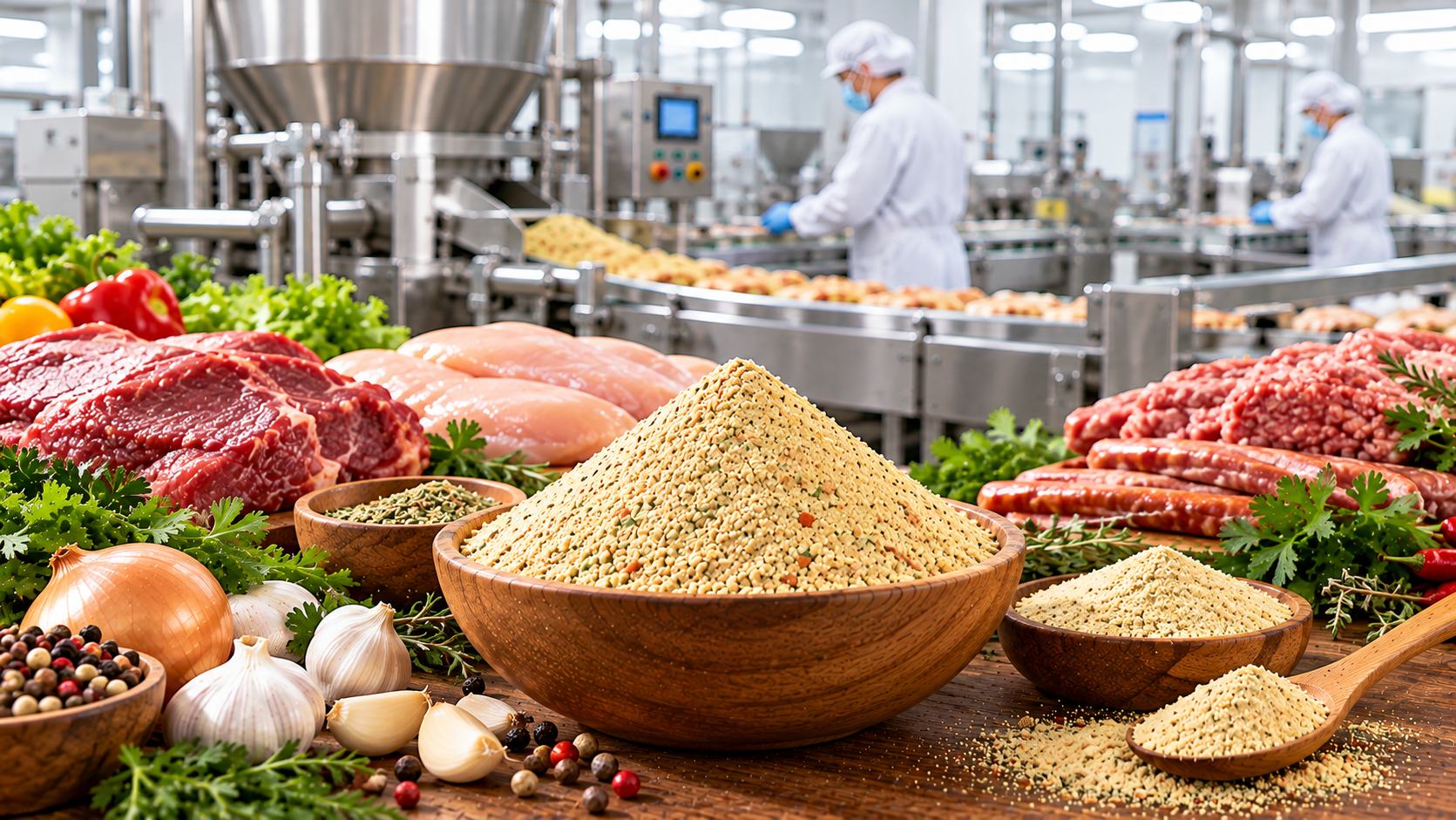
China has a large savory seasoning industry supplying compound seasoning powders, meat seasonings, chicken and beef seasonings, broth systems, soup bases, umami seasonings and customized flavor solutions for commercial food manufacturers.
However, the best savory seasoning manufacturer in China is not necessarily the largest company or the supplier offering the lowest price.
An instant noodle manufacturer may need a different savory system from a processed meat producer, snack company, soup manufacturer or sauce factory. Buyers may also have different requirements for flavor profile, processing performance, technical support, customization, certification and purchasing volume.
This guide introduces several savory seasoning manufacturers in China worth considering and explains how B2B food manufacturers can compare suppliers according to their actual application.
What Is Savory Seasoning?
Savory seasoning is a broad category covering seasoning systems used to build salty, umami, meaty, brothy, roasted, cooked and other non-sweet flavor profiles.
Depending on the product and application, a savory seasoning may help contribute to:
- umami and savory intensity;
- meat or poultry character;
- broth body;
- salt balance;
- spice integration;
- overall flavor body;
- cooked or roasted notes;
- and aftertaste.
Some savory seasonings are complete compound seasoning systems, while others are designed to support a specific part of the finished flavor profile.
What Makes a Good Savory Seasoning Manufacturer?
The right manufacturer depends on the food being produced and the role the seasoning needs to play.
Important factors may include:
- application experience;
- compound seasoning capability;
- meat and savory flavor expertise;
- sample support;
- custom formulation capability;
- performance after processing;
- technical documentation;
- certification requirements;
- packaging options;
- minimum order quantity;
- export experience;
- and expected purchasing volume.
The manufacturers below are not presented as a strict numerical ranking. They represent different strengths within China’s savory and compound seasoning industry.
Savory Seasoning Manufacturers in China Worth Considering
1. Qingdao Ruikelai Food Ingredients Co., Ltd.
Qingdao Ruikelai focuses strongly on industrial food flavors, savory seasoning blends and customized seasoning solutions for B2B food manufacturers.
Its product structure covers savory seasonings, meat seasonings, chicken bouillon seasonings, bone broth seasonings, barbecue seasoning, meat flavor enhancers and customized flavor systems.
This makes the company particularly relevant to food manufacturers looking for application-oriented savory solutions rather than only standard retail seasoning products.
Potential fit:
- processed meat products;
- instant noodles;
- soups and broth;
- bouillon applications;
- snack seasoning;
- barbecue products;
- sauces;
- ready-to-eat foods;
- custom savory seasoning development.
2. Anji Food Co., Ltd.
Anji Food is an established Chinese compound seasoning manufacturer with a broad savory product portfolio.
Its commercial categories include pork rib seasoning, beef-flavored seasoning, bone soup seasoning, chicken fresh seasoning, compound seasoning powders, sauces and other catering-oriented seasoning products.
The company also provides flavor solutions for catering and industrial users, making it relevant to buyers looking for several savory seasoning categories through one established manufacturer.
Potential fit:
- meat-flavored seasoning;
- chicken and beef seasoning;
- bone broth seasoning;
- compound seasoning powder;
- soup products;
- catering seasonings;
- industrial savory applications.
3. Zhengweixuan Food Technology Co., Ltd.
Zhengweixuan specializes in food flavors, compound seasonings and catering ingredients for food processing companies.
Its product range includes powder flavors, paste flavors, liquid flavors and compound seasoning products, while its application areas include both the compound seasoning industry and meat processing.
This combination may be useful when a manufacturer needs both a complete seasoning structure and additional savory flavor components within the same product development project.
Potential fit:
- compound seasoning;
- meat processing;
- powder savory flavors;
- meat flavor systems;
- soup and sauce applications;
- custom flavor development.
4. Shanghai Totole Food Ltd.
Totole is a well-known Chinese seasoning company with extensive experience in chicken bouillon, chicken powder flavor seasoning and freshness-enhancing seasoning products.
Its portfolio includes solid compound seasonings, liquid freshness-enhancing seasonings, chicken bouillon, chicken powder, soup base products and umami-enhancing products.
Totole may be particularly relevant when the target application requires chicken-oriented savory taste, broth character or umami enhancement in standardized foodservice or seasoning products.
Potential fit:
- chicken seasoning;
- chicken bouillon;
- broth seasoning;
- umami seasoning;
- soup bases;
- foodservice savory applications.
5. Sichuan Teway Food Group Co., Ltd.
Sichuan Teway Food Group is a large Chinese compound seasoning manufacturer focused on the research, production and sales of seasoning products.
Its portfolio covers ready-to-cook seasonings, hot pot seasonings, sauces and customized seasoning solutions for catering and other commercial applications.
Teway is particularly relevant to buyers developing Chinese-style savory flavor systems, cooking sauces, hot pot products or standardized compound seasoning programs.
Potential fit:
- Chinese compound seasoning;
- hot pot seasoning;
- ready-to-cook seasoning;
- sauces;
- foodservice applications;
- custom compound seasoning projects.
Quick Comparison of Savory Seasoning Manufacturers in China
| Manufacturer | Main Strength | Potential Applications |
|---|---|---|
| Qingdao Ruikelai | Industrial savory seasoning and customized flavor systems | Meat, noodles, broth, snacks, sauces and customized B2B food applications |
| Anji Food | Broad compound savory seasoning portfolio | Meat, chicken, beef, broth, soup and catering applications |
| Zhengweixuan | Food flavors and compound seasoning | Meat processing, savory flavor systems and customized food development |
| Shanghai Totole | Chicken, bouillon and freshness-enhancing seasoning | Chicken seasoning, soup, broth, umami and foodservice products |
| Sichuan Teway | Large-scale compound seasoning | Chinese savory seasoning, hot pot, sauces and ready-to-cook products |
Which Foods Use Savory Seasoning?
Savory seasoning can be used across a wide range of commercial food categories.
Typical applications include:
- instant noodles;
- instant soups;
- bouillon and stock products;
- processed meat;
- prepared poultry;
- snacks;
- sauces;
- seasoning powders;
- frozen foods;
- ready meals;
- meat fillings;
- hot pot products;
- and other savory foods.
The right seasoning system depends on both the food matrix and the target consumer profile.
Savory Seasoning vs. Meat Seasoning
Savory seasoning is a broader category than meat seasoning.
A savory seasoning may be developed for meat, poultry, seafood, soup, noodles, snacks, sauces or other non-sweet applications.
Meat seasoning is more specifically designed around meat-related applications and may contain a stronger meat, spice or cooked-meat direction.
Food manufacturers should therefore describe the actual finished product instead of simply asking for a generic savory powder.
Savory Seasoning vs. Flavor Powder
A compound savory seasoning and a flavor powder may serve different roles.
Savory seasoning normally contributes to a broader taste structure, which may include umami, salt balance, broth body, spices and overall flavor fullness.
Flavor powder is generally more focused on providing or strengthening a particular aroma or flavor character, such as chicken, beef or roasted meat.
Depending on the formulation, both may be used together for complementary purposes.
Savory Seasoning vs. Savory Meat Flavor Enhancer
A savory meat flavor enhancer is normally more focused on increasing meat perception, savory depth and overall flavor body within an existing formulation.
A complete savory seasoning can have a broader role and may provide much of the finished taste structure.
For example, a meat manufacturer may already have an established salt and spice system but still need stronger meat body and longer aftertaste. In this case, a savory meat flavor enhancer may be more relevant than replacing the complete seasoning system.
What About Yeast Extract and HVP?
Yeast extract and hydrolyzed vegetable protein are commonly used savory ingredients, but they should not automatically be treated as complete compound seasonings.
Depending on the formulation, these ingredients may contribute savory depth, umami, roasted notes or flavor body.
A complete savory seasoning may contain or work together with different savory ingredients depending on its formulation.
Buyers should confirm the exact composition and function of the specific product with the supplier.
Savory Seasoning for Instant Noodles
Instant noodle seasoning needs to perform after dilution and work together with salt, oil, spices, dehydrated vegetables and other components.
Important evaluation points may include:
- broth body;
- savory intensity;
- meat or poultry character;
- salt balance;
- spice integration;
- aroma after preparation;
- and aftertaste.
A strong dry powder aroma does not necessarily mean better performance in the prepared noodle soup.
Savory Seasoning for Soups and Bouillon
Soup and bouillon applications typically require good flavor expression after the seasoning is dissolved or diluted.
Manufacturers may need to evaluate broth character, umami, meat notes, body, salt balance and overall taste after preparation.
The requirements for chicken bouillon, beef bouillon, instant soup and general stock powder may be different, so the target application should be clearly communicated.
Savory Seasoning for Processed Meat
Processed meat products place different demands on seasoning because heating, fat, protein and processing time can change flavor performance.
A meat seasoning system may need to maintain savory depth while integrating with spices, meat character and the actual processing conditions.
For sausages, meatballs, cooked meat and other processed meat applications, sample testing should be carried out after the complete production-style process.
Savory Seasoning for Snack Foods
Snack seasoning may require concentrated flavor impact because the seasoning is often applied to the surface of the finished product.
The savory profile should work together with salt, oil or fat, the snack base and other seasonings.
Possible directions may include:
- chicken;
- beef;
- barbecue;
- roasted meat;
- cheese-savory combinations;
- seafood;
- spicy savory;
- or broth-style profiles.
Savory Seasoning for Sauces and Prepared Foods
Sauces and prepared foods may contain salt, sugar, fat, protein, starch, spices and other ingredients that influence flavor perception.
A savory seasoning should therefore be evaluated in the complete finished formulation.
For heated sauces or ready meals, processing performance can also be an important consideration.
Standard Product or Customized Savory Solution?
For some projects, an existing standard seasoning may provide a suitable starting point.
Other projects may require adjustment when the buyer has:
- a specific regional taste preference;
- a benchmark product;
- an existing formulation;
- a processing-related flavor problem;
- a specific meat or broth direction;
- or a new product concept.
The actual customization scope depends on the supplier and product and should be confirmed directly.
Why Sample Testing Matters
Savory seasonings should preferably be evaluated in the actual finished food rather than only as dry powder.
Flavor performance may change because of:
- water;
- fat;
- protein;
- starch;
- salt;
- spices;
- heating temperature;
- processing time;
- and storage conditions.
Testing under conditions close to commercial production provides a more realistic understanding of how the seasoning performs.
How Should Buyers Compare Samples?
When comparing several Chinese savory seasoning manufacturers, samples should be tested under consistent conditions whenever possible.
Buyers may evaluate:
- savory and umami intensity;
- target flavor character;
- broth or flavor body;
- salt balance;
- spice integration;
- performance after heating;
- aftertaste;
- off-notes;
- dosage efficiency;
- and similarity to the target benchmark.
Specific feedback can help the supplier recommend a better direction.
For example, “the overall umami is sufficient, but we need more broth body and a longer aftertaste” is more useful than simply saying “the sample is weak.”
What Information Should You Send to a Savory Seasoning Manufacturer?
A useful B2B inquiry should describe the actual food project.
Information may include:
- finished product type;
- target country or market;
- desired flavor profile;
- current formulation, where appropriate;
- benchmark product, if available;
- processing method;
- main flavor problem;
- estimated purchasing volume;
- packaging requirements;
- and required technical or certification documents.
This helps the supplier understand whether the project needs a complete compound seasoning, a meat seasoning, a flavor powder, a broth system or another savory solution.
What Should Buyers Confirm Before Ordering?
Before commercial purchasing, buyers should confirm the conditions for the specific product being evaluated.
Depending on the project, this may include:
- product specification;
- ingredient information;
- available technical documents;
- sample availability;
- packaging options;
- minimum order quantity;
- price;
- production lead time;
- export documentation;
- and application support.
These details vary by product and supplier and should not be assumed before confirmation.
How Should Buyers Check Halal Requirements?
Halal requirements may be important for savory seasonings intended for Muslim markets, especially products involving meat or poultry flavor directions.
Buyers should confirm the specific product and certificate rather than relying on a general company-level statement.
Important items may include:
- specific product coverage;
- certificate holder;
- manufacturing site;
- certificate validity;
- certification body;
- and acceptance in the target market.
A company’s Halal certification does not automatically mean that every savory seasoning product is covered.
How to Request a Quote from a Chinese Savory Seasoning Manufacturer
A useful RFQ might look like this:
We manufacture for the [country/market] market and are looking for a savory seasoning with a [chicken / beef / broth / roasted meat / umami / other] profile. Our processing method is [process] and our estimated purchasing volume is [quantity]. We would like to evaluate samples before commercial ordering. Please advise suitable products, packaging, MOQ, available documents and commercial terms.
This gives the supplier a clearer basis for recommending an appropriate product.
Which Savory Seasoning Manufacturer in China Should You Choose?
The answer depends on the application.
A noodle manufacturer may prioritize broth body and flavor after dilution.
A processed meat producer may place more importance on meat character and performance after heating.
A snack manufacturer may need strong surface seasoning impact.
A soup or bouillon manufacturer may focus on umami, broth depth and consistency after preparation.
A company developing a new product may value customized flavor development and sample support more highly.
Instead of asking only:
“Who is the biggest savory seasoning manufacturer in China?”
a better question is:
“Which Chinese savory seasoning manufacturer best matches my finished product, target flavor, processing method, market and purchasing requirements?”
Looking for Savory Seasoning Solutions from China?
ZXS Flavors works with seasoning and savory flavor solutions for commercial food manufacturing.
Current sourcing directions include chicken seasoning, beef seasoning, processed meat seasoning, bouillon seasoning, savory meat flavor enhancement and other compound savory applications.
If you are developing noodles, soups, bouillon, processed meat, snacks, sauces, frozen foods or other savory products, send us your finished product type, processing method, target flavor, benchmark and sample requirements.
We can review the project and discuss suitable seasoning directions according to the actual application and available supply source.
Contact ZXS Flavors to discuss your savory seasoning project, request product information or arrange sample evaluation.