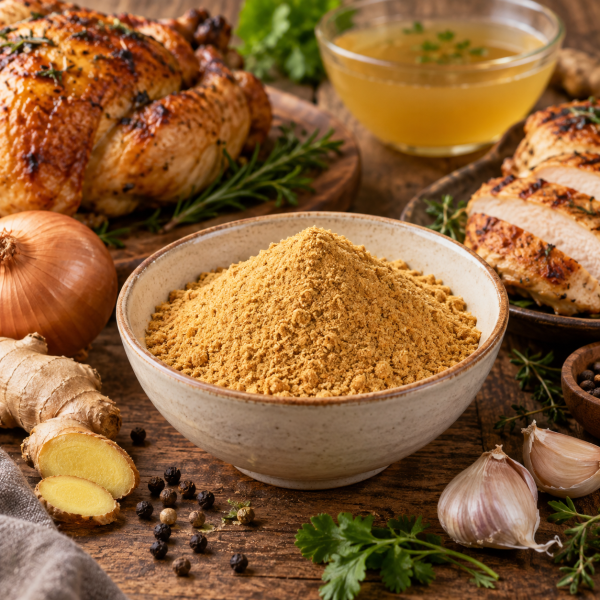
Quick Answer: Chicken Reaction Flavor is a savory flavor solution developed for food manufacturers that need stronger cooked, roasted and deeper chicken-style flavor characteristics in finished food applications. It can be evaluated as part of a broader flavor system together with Seasoning Blends or Flavor Bases, depending on the target product, processing conditions and desired sensory profile.
Chicken flavor is widely used in instant noodles, soups, snacks, sauces, frozen foods, ready meals and other savory food applications.
However, not every product needs the same type of chicken flavor.
Some formulations already have enough salt, spices and umami, but still lack the cooked or roasted chicken character that gives the finished product more depth and realism.
In these situations, a Chicken Reaction Flavor may be considered as part of the overall flavor system.
What Is Chicken Reaction Flavor?
Chicken Reaction Flavor is designed around cooked and thermal chicken-style flavor characteristics.
Depending on the target application, it can be developed to support sensory directions such as:
- cooked chicken character;
- roasted chicken notes;
- deeper savory perception;
- meaty flavor direction;
- broth depth;
- and stronger cooked-food character.
The final flavor direction should be selected according to the actual food application rather than treating one chicken profile as suitable for every product.
Chicken Reaction Flavor vs. Chicken Flavor Base
Chicken Reaction Flavor and Chicken Flavor Base can serve different roles in a formulation.
Chicken Reaction Flavor is more focused on cooked, roasted and thermal chicken-style characteristics.
Chicken Flavor Base is more focused on the underlying chicken-style savory foundation, umami, body and flavor depth.
A food manufacturer may use one of them or evaluate both as part of a broader flavor system, depending on the desired finished profile.
For example, a broth may already have acceptable body and umami but still need more cooked chicken character. In another product, the chicken aroma may be noticeable but the underlying savory foundation may still feel weak.
These are different formulation problems and should be evaluated separately.
Chicken Reaction Flavor vs. Chicken Seasoning Blend
A Chicken Seasoning Blend is intended to support the overall seasoning profile.
This may include the balance of:
- saltiness;
- umami;
- spices;
- aroma;
- sweetness;
- savory character;
- and overall chicken flavor direction.
Chicken Reaction Flavor has a more focused role.
It is typically evaluated when the finished product needs stronger cooked, roasted or thermal chicken-style characteristics rather than simply more total seasoning.
Applications for Chicken Reaction Flavor
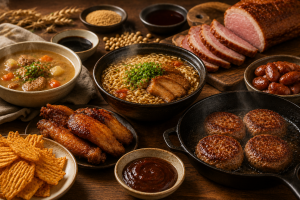
Chicken Reaction Flavor can be evaluated for a range of savory food applications, including:
- instant noodles;
- soups and broths;
- snack seasonings;
- sauces;
- processed meat products;
- frozen foods;
- ready meals;
- and other savory food systems.
The most suitable flavor direction depends on the final food, processing method and target sensory result.
Chicken Reaction Flavor for Instant Noodles
Instant noodle broth often requires more than simple chicken aroma.
The final eating experience may depend on the balance between:
- chicken character;
- broth body;
- umami;
- saltiness;
- spices;
- cooked notes;
- and aftertaste.
Chicken Reaction Flavor can be evaluated when the broth needs stronger cooked or roasted chicken-style character.
It can also be considered together with a Chicken Flavor Base and a complete Seasoning Blend when the product requires both flavor depth and overall seasoning balance.
Chicken Reaction Flavor for Soups and Broths
Soup products may smell like chicken but still lack the deeper cooked character expected from a richer broth.
In these applications, manufacturers can evaluate whether the missing sensory dimension is:
- aroma;
- cooked chicken character;
- broth body;
- umami;
- meaty depth;
- or overall balance.
If the main gap is cooked or roasted character, a Reaction Flavor may be more relevant than simply increasing the total seasoning level.
Chicken Reaction Flavor for Snacks
Chicken-style snack seasoning often needs a clear flavor impact in a dry or low-moisture application.
Depending on the product concept, manufacturers may target:
- roasted chicken direction;
- cooked chicken direction;
- savory meaty character;
- or a broader chicken seasoning profile.
Chicken Reaction Flavor can be evaluated as one component of the complete snack seasoning system.
Chicken Reaction Flavor for Sauces and Ready Meals
Sauces and ready meals may contain many other flavor components, including salt, sugar, oil, spices, vegetables and other savory ingredients.
In these more complex formulations, chicken character may become less distinct.
A Chicken Reaction Flavor can be evaluated when the target product needs a clearer cooked chicken direction or deeper thermal flavor character within the complete formulation.
Chicken Reaction Flavor for Frozen Foods
Frozen foods can go through several processing and preparation stages before consumption.
These may include:
- mixing;
- freezing;
- storage;
- thawing;
- steaming;
- boiling;
- frying;
- or reheating.
For this reason, the flavor should be evaluated in the final prepared product rather than only before freezing.
Manufacturers should compare the chicken character before and after the complete preparation process.
How to Select the Right Chicken Reaction Flavor Direction
Before requesting a sample, food manufacturers should define the target sensory profile as clearly as possible.
Useful information may include:
- final food application;
- target chicken flavor direction;
- whether the profile should feel more cooked, roasted or savory;
- current formulation problem;
- benchmark product if available;
- processing method;
- and feedback from previous samples.
This helps make sample development more focused.
Test in the Actual Food Application
Chicken Reaction Flavor should ideally be evaluated in the intended finished food system.
The same flavor may perform differently in:
- a noodle broth;
- a dry snack coating;
- a meat filling;
- a sauce;
- or a frozen ready meal.
Application testing helps determine whether the flavor direction fits the real product and whether additional adjustment is required.
Combining Reaction Flavor, Flavor Base and Seasoning Blend
For some products, one flavor component may be sufficient.
For others, a more complete system may be required.
A manufacturer may evaluate:
- Seasoning Blend for overall taste balance;
- Flavor Base for savory foundation, body and umami;
- Reaction Flavor for cooked, roasted and thermal flavor characteristics.
These components should not automatically be treated as substitutes for one another.
The correct combination depends on the sensory target and the finished application.
Custom Chicken Flavor Development
Chicken Reaction Flavor can be discussed according to the customer’s specific product and target flavor direction.
Useful project information includes:
- food application;
- target sensory profile;
- processing conditions;
- current flavor system;
- main flavor problem;
- benchmark product;
- and required development direction.
This allows sample evaluation to focus on the actual application rather than using a generic chicken flavor profile.
Chicken Reaction Flavor Supplier in China
Zhongxinsheng Flavor Co., Ltd. develops Reaction Flavors, Flavor Bases, Seasoning Blends and savory flavor solutions for food manufacturers.
Our development approach focuses on the finished food application and the required sensory result.
Explore our Reaction Flavors or browse our food seasoning and flavor products.
For a Chicken Reaction Flavor project, contact us through WhatsApp and share your application, target flavor profile and current product development needs.