
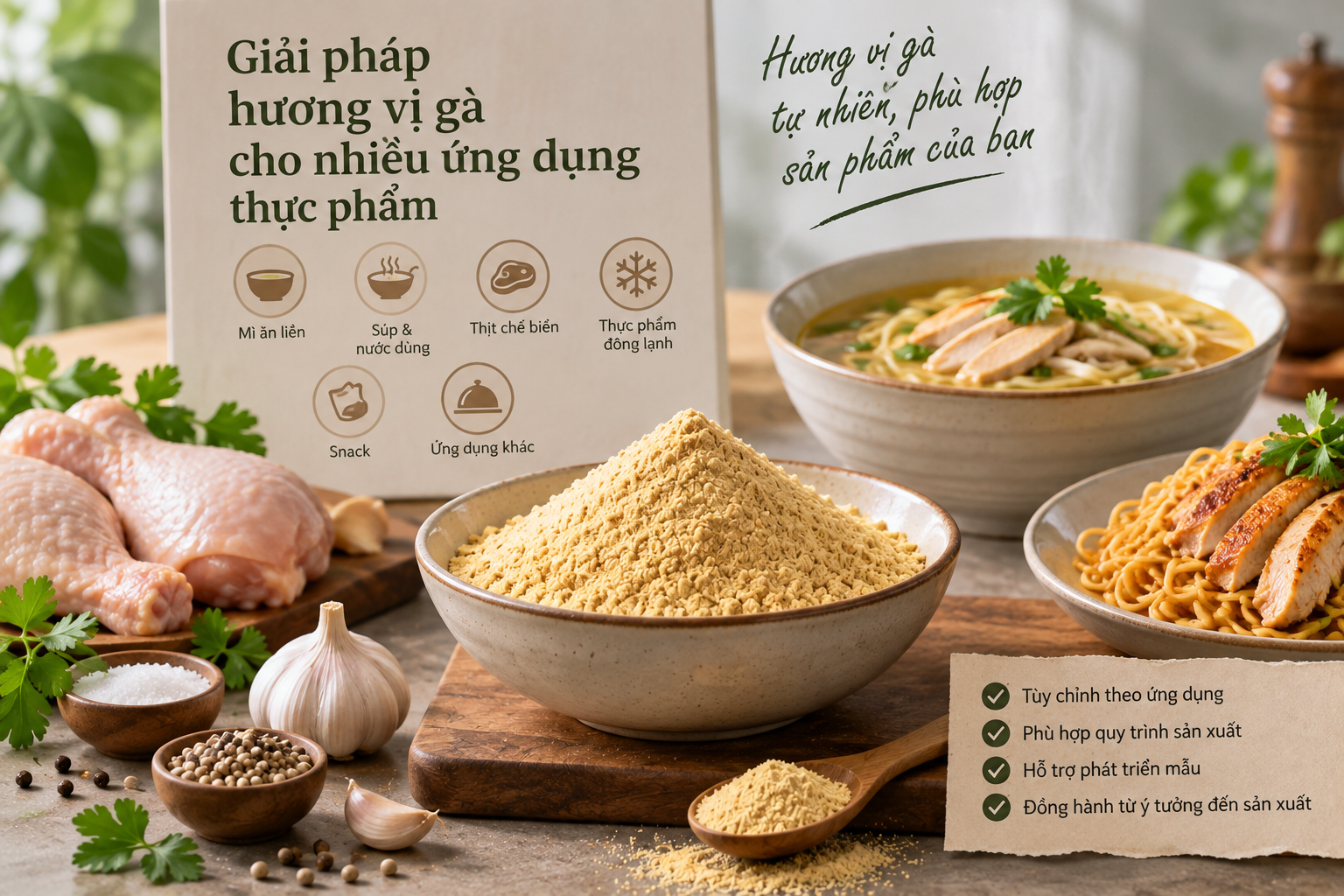
Are you looking for chicken seasoning powder for instant noodles, soups, broths, snacks, frozen foods, processed meat, or other savory food applications?
For food manufacturers, “chicken flavor” is not a single flavor profile.
One product may need a light and clean chicken broth profile, while another may require a richer chicken character with more body, cooked notes, roasted notes, or stronger savory depth.
For this reason, the key question is not simply “Is the chicken flavor strong enough?” but rather “Is this chicken flavor suitable for the final food application?”
Different chicken flavor systems can be built using chicken seasoning blends, flavor bases, reaction flavors, and other savory components depending on the target product.
Chicken Flavor Can Be Developed in Different Directions
When a buyer asks for chicken seasoning powder, it is important to define the target flavor profile clearly.
Common directions may include:
- chicken broth style;
- light chicken flavor;
- rich chicken flavor;
- cooked chicken;
- roasted chicken;
- savory chicken;
- or a customized chicken profile for a specific food application.
Two products may both be described as “chicken seasoning,” but they can perform very differently in aroma, body, umami, meatiness, flavor intensity, and aftertaste.
When Is a Chicken Broth Profile More Suitable?
For soup noodles, soups, broths, and other applications that require a clear broth character, a chicken broth style may be more suitable.
Manufacturers may need to consider:
- broth fullness;
- body;
- umami;
- chicken character;
- the balance between saltiness and savory taste;
- and aftertaste.
A very strong chicken aroma does not automatically create a better broth if the flavor base is still thin or unbalanced.
In this case, the seasoning blend may need to be evaluated together with a flavor base or broth seasoning base.
When Should You Choose a Light and Clean Chicken Flavor?
Not every food product requires a strong chicken profile.
Some noodles, soups, frozen foods, and lightly flavored savory products may work better with a cleaner, softer chicken character.
The target may include:
- moderate chicken aroma;
- a balanced savory base;
- limited roasted character;
- less heavy meatiness;
- and good compatibility with other ingredients in the formula.
This is especially important when chicken flavor is intended to support the overall formula rather than become the dominant flavor.
When Is a Richer Chicken Flavor Needed?
Some applications require a clearer chicken identity and stronger body.
The target may include:
- stronger meat character;
- more body;
- a longer savory aftertaste;
- a richer broth sensation;
- or a more noticeable chicken flavor profile.
Simply increasing the dosage of seasoning powder is not always the best solution.
If the main weakness is body or savory depth, a chicken flavor base may be more useful as part of the complete flavor system.
What Is the Difference Between Cooked Chicken and Roasted Chicken?
For some products, the most important difference is not flavor intensity but aroma direction.
Cooked chicken profiles tend to give a more natural cooked-meat impression, while roasted chicken profiles focus more on roasted, browned, grilled, or toasted characteristics.
These differences can be important in:
- strong chicken instant noodles;
- chicken-flavored snacks;
- processed meat products;
- frozen foods;
- and other savory products requiring cooked or roasted character.
If these characteristics are needed, reaction flavors may be considered as part of the flavor system.
Is Chicken Seasoning Powder the Same as a Chicken Flavor Base?
Chicken seasoning powder and chicken flavor base can perform different functions.
A seasoning blend usually helps build a more complete overall taste structure, including saltiness, umami, spices, and chicken flavor.
A chicken flavor base may focus more on:
- body;
- savory depth;
- meatiness;
- broth character;
- and mouthfeel.
In many applications, the two can be used together rather than replacing each other.
The correct choice depends on what is actually missing from the finished product.
What Is the Role of Reaction Chicken Flavor?
If a product already has a basic chicken taste but still lacks cooked, roasted, or meaty character, a reaction chicken flavor may be considered.
Reaction flavors can help strengthen characteristics such as:
- cooked chicken;
- roasted chicken;
- meaty notes;
- and other savory notes.
However, reaction flavor is not a stand-alone solution for every application.
It should be evaluated together with the seasoning blend, flavor base, and actual food formulation.
What Type of Chicken Flavor Works Best for Instant Noodles?
The format of the noodle product can strongly influence the choice of chicken seasoning.
Soup Noodles
Soup noodles may require more emphasis on:
- broth body;
- umami;
- chicken character;
- aroma release after hot-water preparation;
- and aftertaste.
Dry or Stirred Noodles
Dry noodles or mixed noodles may require more attention to:
- seasoning adhesion;
- interaction with oil;
- aroma after mixing;
- flavor intensity;
- and flavor retention after preparation.
For this reason, the same chicken seasoning powder may not perform equally well in both product formats.
Chicken Flavor for Snacks and Processed Foods Requires a Different Approach
For snacks, manufacturers may focus more on aroma impact, seasoning adhesion, oil compatibility, and flavor intensity.
For processed meat or frozen foods, flavor performance after heating may become more important.
Each food application has a different environment involving water, oil, fat, protein, starch, and processing temperature.
Therefore, seasoning samples should be tested in the actual food matrix before final approval.
A Reference Product Can Make Flavor Development More Efficient
If you are developing a product based on an existing benchmark, the reference sample can help define the target flavor direction more clearly.
Useful information may include:
- the reference product;
- what you like about the flavor;
- whether the chicken aroma should be stronger or lighter;
- whether more or less body is required;
- whether cooked or roasted notes are present;
- the desired aftertaste;
- and what should be changed compared with the reference.
The more specific the feedback is, the more focused the sample development process can be.
What If You Do Not Have a Reference Sample?
A project can still begin without a benchmark.
It is more useful to describe the target product in practical terms, for example:
- light chicken soup noodles;
- rich chicken instant noodles;
- chicken broth with more body;
- roasted chicken seasoning for snacks;
- chicken seasoning for frozen foods;
- or a savory chicken profile for processed foods.
Descriptions like these provide much more useful direction than simply saying “we need chicken flavor.”
What Information Should You Provide When Requesting a Chicken Seasoning Sample?
If you are sourcing chicken seasoning powder for food manufacturing, it is helpful to provide:
- Product type: noodles, soup, snacks, frozen foods, processed meat, or another application.
- Target chicken profile: light, rich, broth, cooked, roasted, or another direction.
- Reference product: if available.
- Main priority: aroma, body, meatiness, umami, aftertaste, or cooked/roasted character.
- Production process: especially heating steps and processing conditions.
- Target market: domestic or export markets.
- Documentation requirements: if specific documents are required, they should be discussed in advance.
Do Not Evaluate Chicken Seasoning Only by Tasting the Powder
A chicken seasoning powder may taste or smell very strong on its own but perform completely differently in the finished food.
Important factors can include:
- water;
- oil and fat;
- protein;
- starch;
- processing temperature;
- heating time;
- and other seasoning ingredients.
For this reason, samples should be evaluated in the actual food product or under conditions that are as close as possible to the final application.
How to Evaluate a Chicken Seasoning Sample
When testing a sample, manufacturers can focus on:
- initial aroma;
- natural chicken character;
- body;
- umami;
- cooked or roasted notes;
- balance with other ingredients;
- aftertaste;
- and changes after heating.
If a sample needs adjustment, specific feedback is much more useful than general comments.
For example, “we need more body but do not want stronger roasted notes” provides clearer technical direction than simply saying “we need stronger chicken flavor.”
Chicken Seasoning Solutions from China for Food Manufacturers
For B2B food manufacturing projects, chicken flavor solutions may include:
- chicken seasoning powder;
- chicken flavor base;
- reaction chicken flavor;
- broth seasoning base;
- seasoning blends;
- and other customized savory solutions.
You can explore more product categories on our Products page or learn more about the company on the About Us page.
Looking for Chicken Seasoning for Your Food Product?
If you are developing instant noodles, soups, snacks, frozen foods, processed meat, or other savory products, you can share:
- your product type;
- the target chicken profile;
- a benchmark if available;
- your production process;
- and the current flavor problem you want to solve.
Based on the project requirements, we can discuss whether a seasoning blend, flavor base, reaction flavor, or a combination of these solutions may be more suitable.
Contact us on WhatsApp to discuss your chicken seasoning requirements.